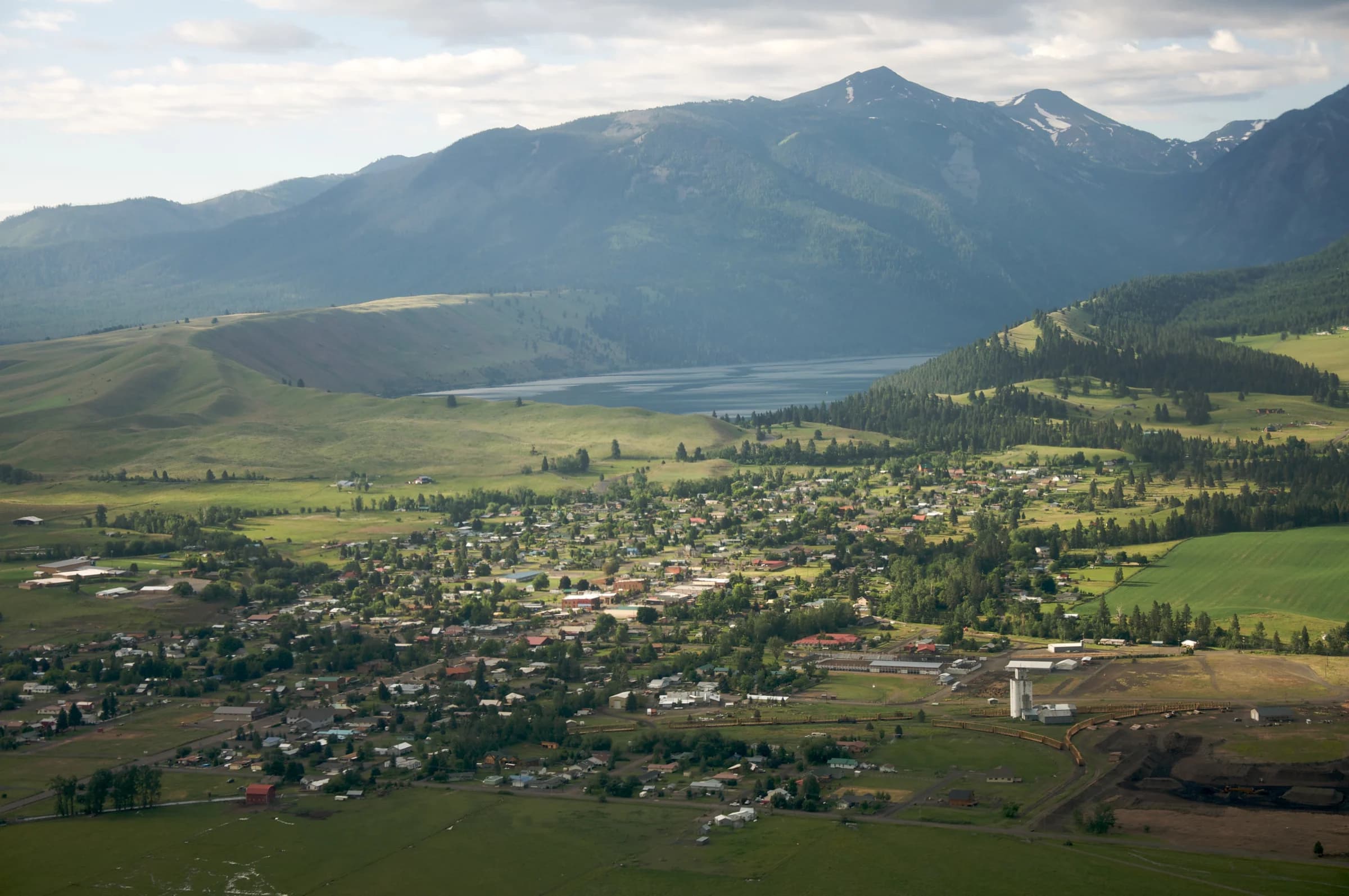
Joseph, working fields and Wallowa Lake below the mountains
Wallowa County · An open conversation

Home,
twenty years from now.

What should change by 2046, and what do you hope will still be here? The visions and surveys made here, and the measurements taken of the county — from a 2006 vision statement to the state’s 2023 population forecast — set beside the questions they leave open. Add what your experience shows.

Begin with the story ↓
Sam Beebe · 2007-07-08 · CC BY 2.0 · Image & source ↗A documentary photograph, not a visualization of the future.

Twenty years back, twenty years forward

In 2006 a vision statement — facilitated by North Carolina State University faculty and guided by the Wallowa County Economic Action Team — described the county its authors wanted: “wide-open spaces and intact ranchlands,” opportunities to “carry agriculture and ranching forward into the next generation,” a place that would “nurture and connect year-round residents, including young people and families,” and “a County with no mega anything” 1. Oregon State University reprinted it in 2010 as the framework, with four 2008 community forums, for 26 indicators and took a first reading: as of 2009 the county was “roughly three-quarters vital, with some clear work to do” 1. Every decade from the 1950s to the 1990s showed net out-migration of 15-to-24-year-olds 1. In 2007 average earnings per job, $25,523, covered 101 percent of a one-parent, one-child budget but 74 percent of a two-parent, one-child budget 1, and the county bought $250 million from outside while selling $165 million out 1. In the 2009 survey, 91 percent of adults thought people here were willing to help their neighbors; 55 percent thought local government could deal effectively with important problems 1.

The census counted 7,226 people in 2000, 7,008 in 2010 and 7,391 in 2020 6. The share aged 65 and older rose from 18.96 percent in 2000 to 29.28 percent in 2020, against 18.04 percent statewide 5.

Later documents return to housing: the county’s 2021 economic analysis found “the need for housing cuts across all discernable socio-economic lines” 2; a three-county needs assessment that year called workforce housing “the biggest concern for interviewees” in its built-environment findings, with broadband second 3; of 86 county respondents to a 2021 foundation survey, 5 percent agreed affordable housing was available where they live 4. The 2020–2024 estimates show 4,349 housing units, 962 vacant, 630 of those held for seasonal or recreational use, and a median owner-occupied value of $394,800 against median household income of $67,112 — near 5.9 to one, by arithmetic 7.

Jobs grew. Covered payroll employment rose from 2,495 in 2015 to 2,855 in 2025, average pay from $32,237 to $55,379 in unadjusted dollars, and government jobs from 648 to 789 10, 9. Retail, disclosed in every year, went from 257 jobs in 2015 to 288 in 2025 across a classification change 10, 9; below the sector level, the largest disclosed private industry in 2025 was ambulatory health care, 219 jobs 9. The 2021 analysis put transfer payments at 29 or 45 percent of 2018 personal income, by two methods it could not reconcile 2. In the year to July 2026, “Wallowa County had the largest job loss over the year, falling by 8.3%” 11.

School enrollment held, in two tabulations of state data: 872 students across four districts in 2009–10 in the county’s 2021 analysis 2; 857 in October 2015 and 878 in October 2025, adding the four district rows in the state’s fall-membership files 8. The total hides a shift — Wallowa’s district from 253 to 199, Joseph’s from 215 to 249 2, 8. Land was protected: 1,791 acres of the East Moraine entered county ownership in January 2020 after almost $6.5 million was raised 12; a January 2023 easement made it permanent 13. The hospital’s 2025 assessment found 28.9 percent of residents 65 or older and 55.7 percent leaving the county for medical care in the past year 14. In 2019, 17 percent of children under six had access to a regulated child care slot, against 23 percent statewide 15.

The official horizon is Portland State University’s 2023 forecast. Adding its age table gives 7,406 people in 2025, 7,184 in 2035 and 6,717 in 2045 5. It expects the 65-and-older share to reach 35.19 percent by 2030 5 and says “by 2040 deaths are expected to outnumber births 3 to 1” 5. Enterprise’s and Joseph’s growth boundaries are forecast to gain, Lostine’s and Wallowa’s to slip, and the area outside all four to fall from 3,011 to 2,290 by 2040 5.

A forecast is a set of assumptions. This one holds net in-migration flat at 36 people a year from 2026, freezes vacancy and household size at 2020 values, and excludes “specific scenarios of climate change, political unrest, or other shocks” 5. The county planning director wrote, in a 2023 survey response the forecasters printed, that “after Covid, there appear to be more people re-locating to the county as they can work remotely” 5. The next twenty years depend on decisions no table contains.

Six storylines

Follow a question into the county.

Part one · Staying and returning
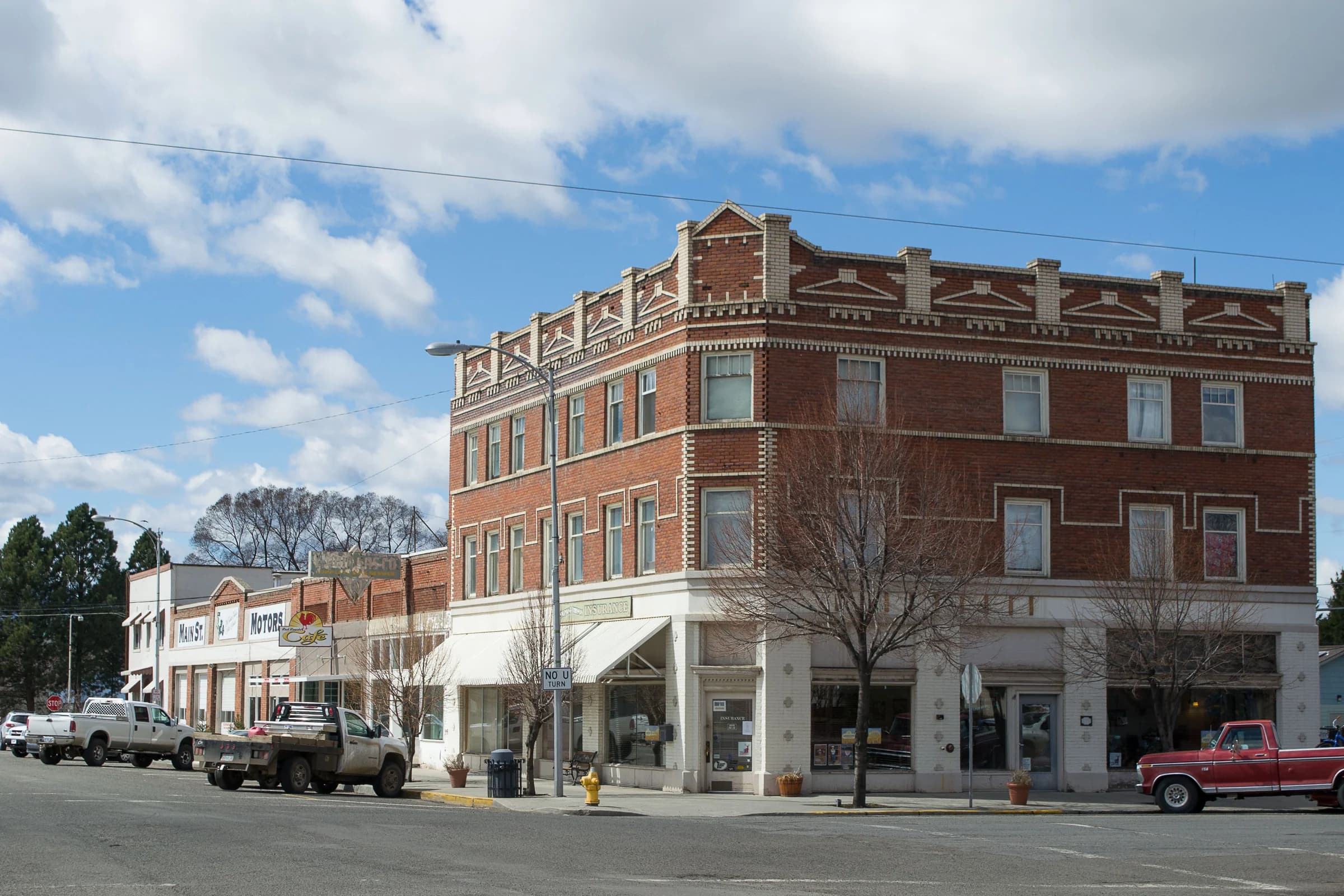
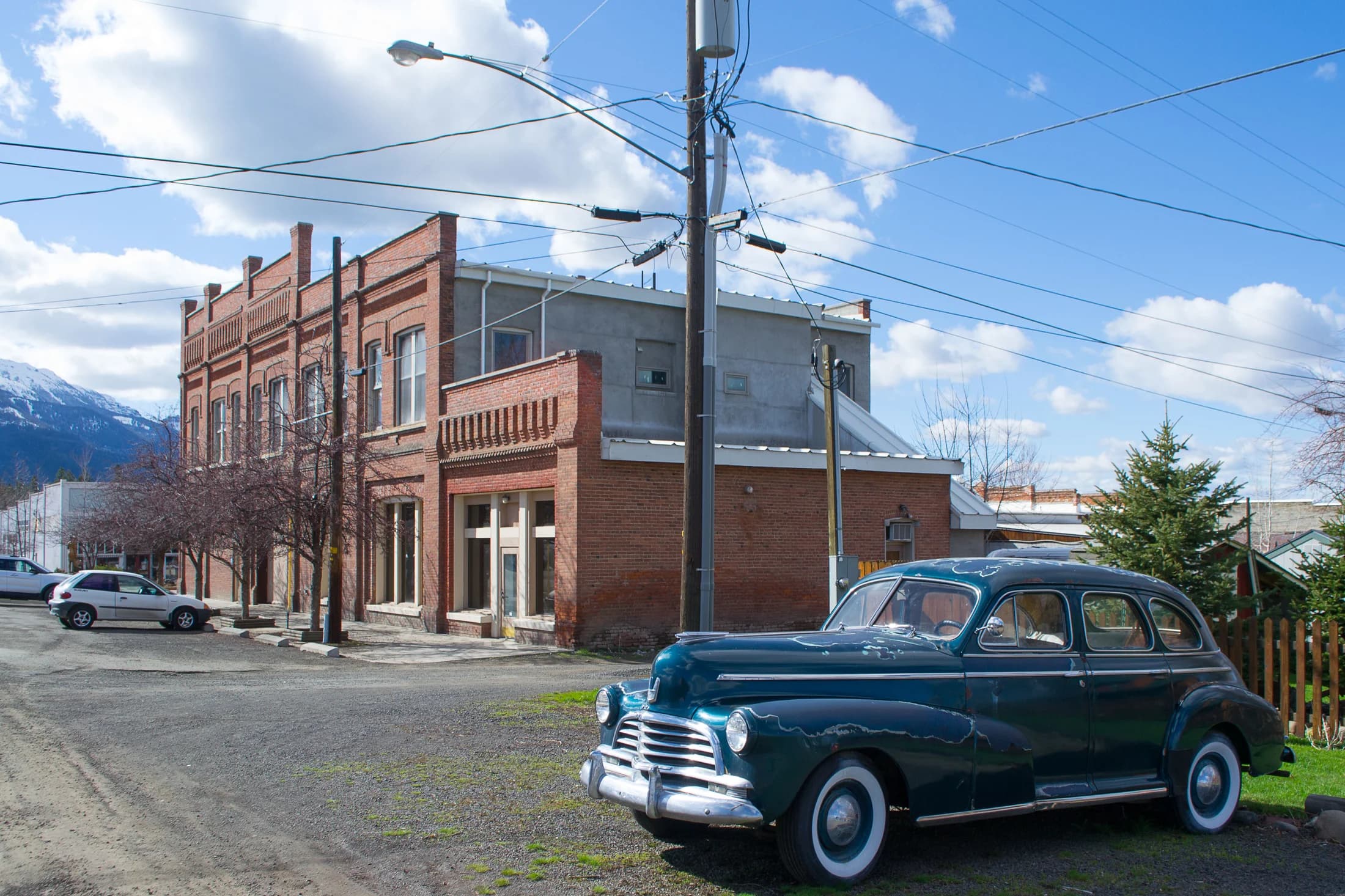
Enterprise’s streets: a setting for this inquiry, not a photograph of an interview participant.
Visitor7 · 2013-04-09 · CC BY-SA 3.0 · Image & source ↗
01 · A story to follow

A place for the next generation

Reported experience

What people here have said. The 2021 analysis reported, as anecdote, that “spouses vetoed moves to the area precisely because there was no housing they regarded as suitable” 2. One 2021 survey respondent wrote: “second and third homes are outpricing the cost/availability of local people’s first homes” 4. The county planning director wrote in 2023: “Business owners note that they have been unable to hire some employees because they can’t find housing” 5. In May 2023, at a meeting with the governor, a Wallowa Resources advisory board member working with Working Homes called the shortage “a stranglehold” on the county’s economic base 16.

Documentary records

What the records show. Two in three children born here between 1978 and 1983 no longer lived in the area as adults, per Opportunity Atlas data in a 2020 foundation report 19. Seasonal homes went from 12.6 percent of units in 2000 1 to about 14.5 percent in 2020–2024, by our arithmetic 7. Working Homes, described by the Chieftain as a nonprofit created by Wallowa Resources, says it acquired Enterprise’s EM&M building — 27 apartments, six commercial spaces — in July 2024 17, 16; upgrades were reported under way in September 2026 18.

Open questions

What is still unknown. Neither the 2009 baseline nor the 2021 analysis gives a housing-unit count or a sale price; the latter reports rent only through a housing-authority table — median $656, undated 2. Whether the county approved accessory dwellings in its Rural Residential zone, facing “some community opposition” in 2023, is not established 5. The 86 respondents averaged 63 years old and eight in ten owned their homes 4; the summary does not say how many rent.

Questions to carry with you
  • What is harder to find now than when you first lived here?
  • What would make a good life possible without inheriting property?
Add your experience or hopes ↗
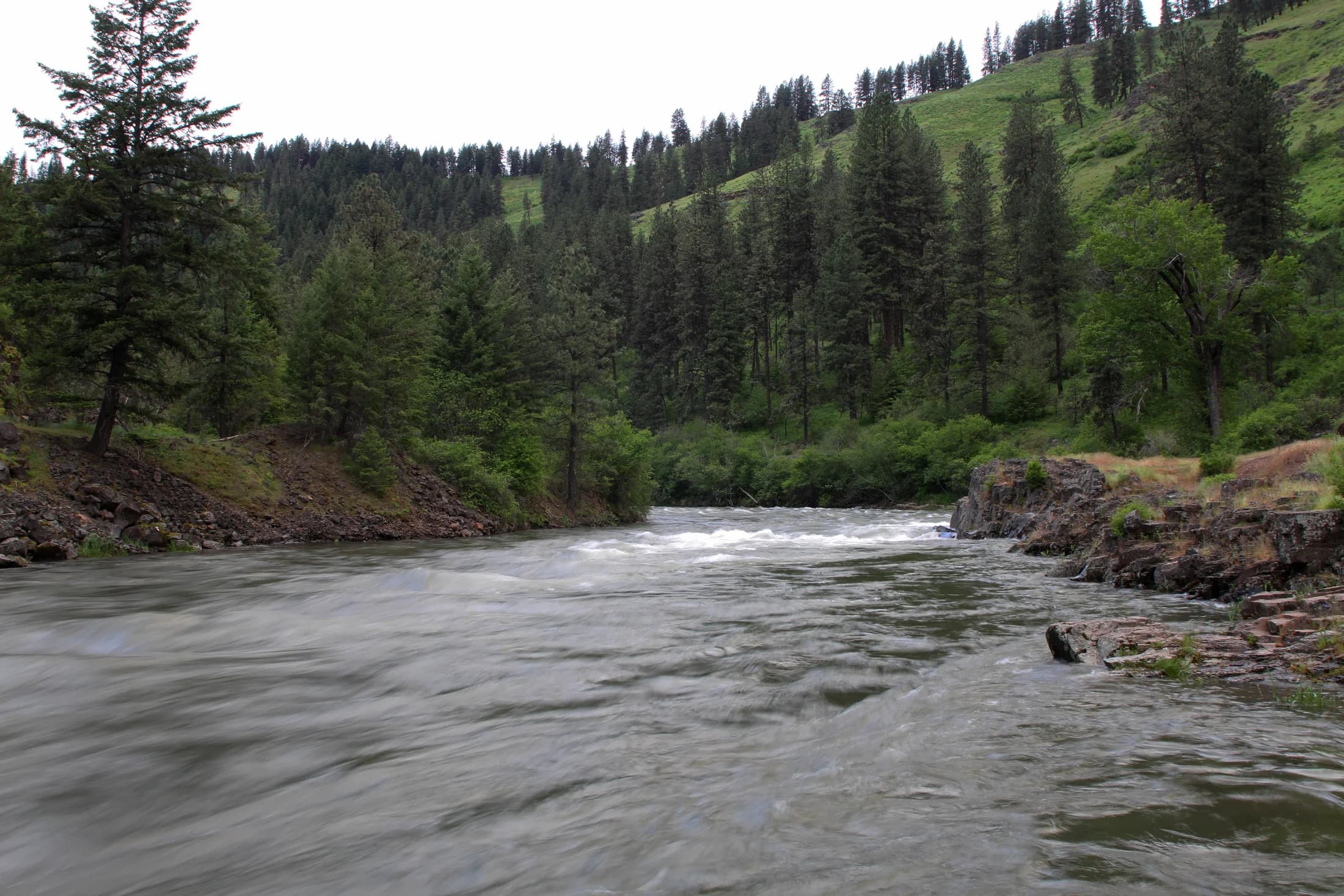
The Wallowa River. This landscape image does not depict a ceremony or a particular cultural site.
Bureau of Land Management Oregon and Washington · 2017-05-25 · Public domain · Image & source ↗
02 · A story to follow

Homecoming is a living story

Reported experience

What people here have said. The Nez Perce Wal’áwa Homeland, a Wallowa nonprofit that calls itself “a landback nonprofit—not a tribal government, land trust, or advocacy campaign” 21, adopted a hundred-year plan in 2023. Within thirty years it wants “Indigenous people of this valley increasingly reside, raise families, work, celebrate, practice culture and walk the land here in wal’áwa,” and names housing, employment and travel costs among the barriers 20. The plan quotes Taz Conner, a wal’wá•ma descendant, in 1994: “It is time once again to let the land hear the familiar sounds that have been developed over thousands of years here in the land of winding waters” 20. Its own account: “few have returned” 21. The Nez Perce Tribe’s history, a separate voice, records a reservation of about 7.5 million acres in 1855 cut to about 750,000 in 1863, and off-reservation rights it says courts upheld 22.

Documentary records

What the records show. The celebration grounds at Wallowa cover 323 acres 20. Its pages disagree on the first gathering: the plan and About page say 1989 20, 21; the Tamkaliks page says 1990 48. The 2026 Tamkaliks was scheduled for July 17–19, closing with a walasit service and friendship feast 48. The Tribe’s fisheries department lists the Lostine River among its production projects 23. Coho reintroduced from 2017 sent more than 5,000 adults past Bonneville Dam in 2020 and reopened a Grande Ronde fishery after forty years 24; in 2021 the Tribe estimated 914 spring/summer Chinook returning to the Lostine 25.

Open questions

What is still unknown. No source counts descendants who have moved back; the plan’s three-year review, due around 2026, is not documented online; Lostine returns after 2021 were not retrieved. The Homeland’s goals are a nonprofit’s intentions, not policy of the Nez Perce, Umatilla or Colville governments, which appear in its records as contributors.

Questions to carry with you
  • What makes belonging possible in everyday life?
  • What knowledge or story should remain within your family or community?
Add your experience or hopes ↗
Part two · Working and caring
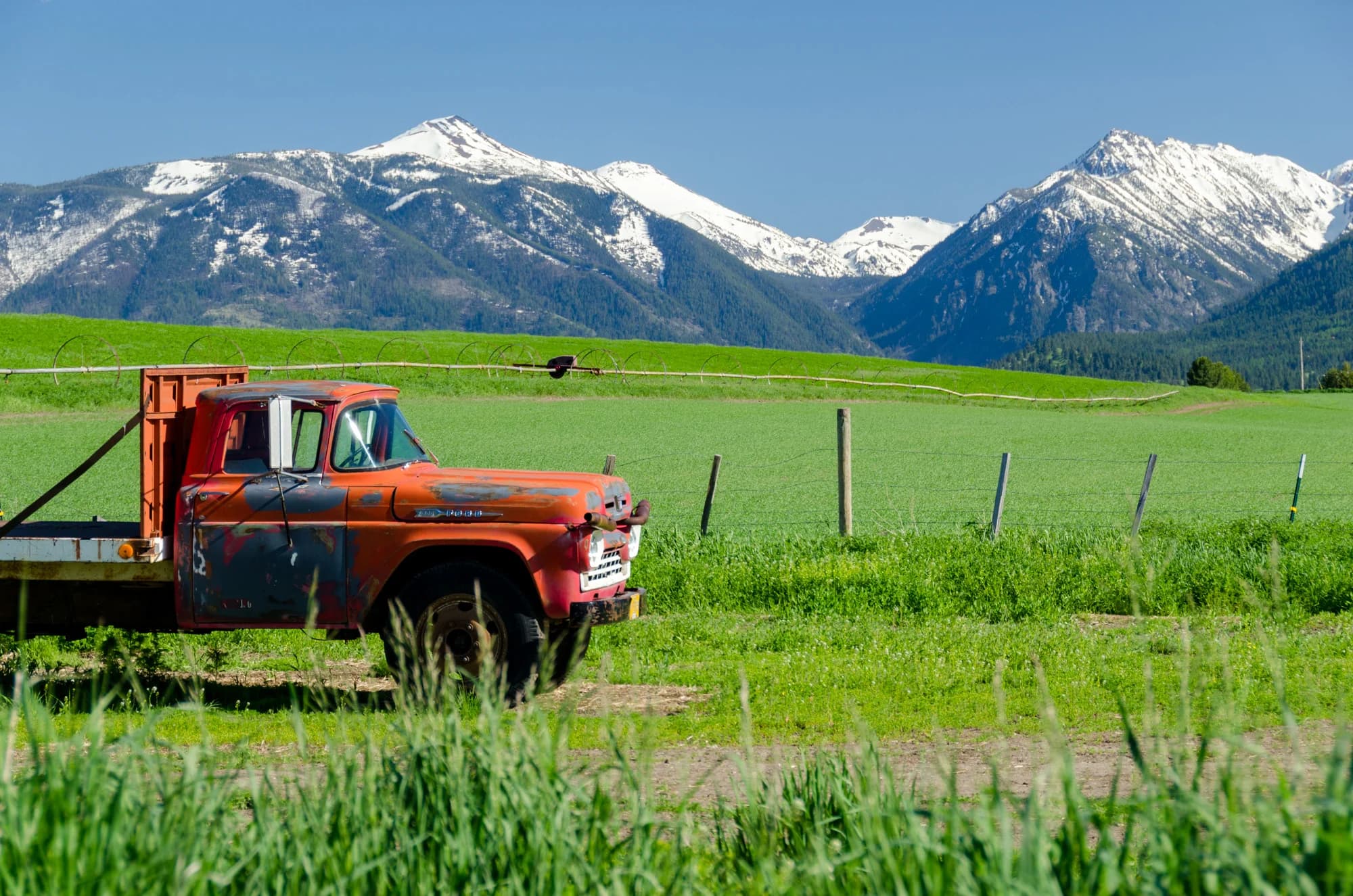
Working land near Enterprise, shown as landscape context.
Gary Halvorson, Oregon State Archives · 14 June 2011 · CC BY 4.0 · Image & source ↗
03 · A story to follow

The work behind the view

Reported experience

What people here have said. Regional interviewees in 2021 named a “lack of affordable and available agricultural land/pasture to support new ranching businesses” 3. Of the 2024 collar trial, the Extension agent said: “we still maintain this as a working landscape. And livestock grazing is a piece of that” 27.

Documentary records

What the records show. Farmland covered about a quarter of the county in 2007, national forest about 56 percent in 2009 1. The 2022 moraine plan recommended 80 cow-calf pairs on the southern pasture for August and September — the 2015 plan had run 100 to 125 south of the elk fence — and costed permanent cross-fencing at $75,000, “one of the most significant barriers” 26; collars followed, at about $18,000 a mile for the wire they replace and $48–$50 a year each on lease 27. A Wallowa rancher wrote in 2011 that “nearly 40 percent of our costs were incurred after the cattle left the ranch” 29; the ranch now processes shares locally and wholesale beef in Brownsville 30. Wallowa Resources reports 423 landowners engaged in Wallowa County in 2024, and 50 forest plans covering 30,093 acres across northeast Oregon 31.

Open questions

What is still unknown. Payroll statistics exclude self-employed ranchers, and the private agricultural line was suppressed in 2025 — 45 establishments visible, workers not 9. The moraine’s acreage appears as 1,791, 1,820 and 1,824 in three documents 12, 26, 13. Trial results were not yet reported 27.

Questions to carry with you
  • Which tasks, costs and skills are invisible from the road?
  • What would make a new tool useful enough to keep, and what would make you reject it?
Add your experience or hopes ↗
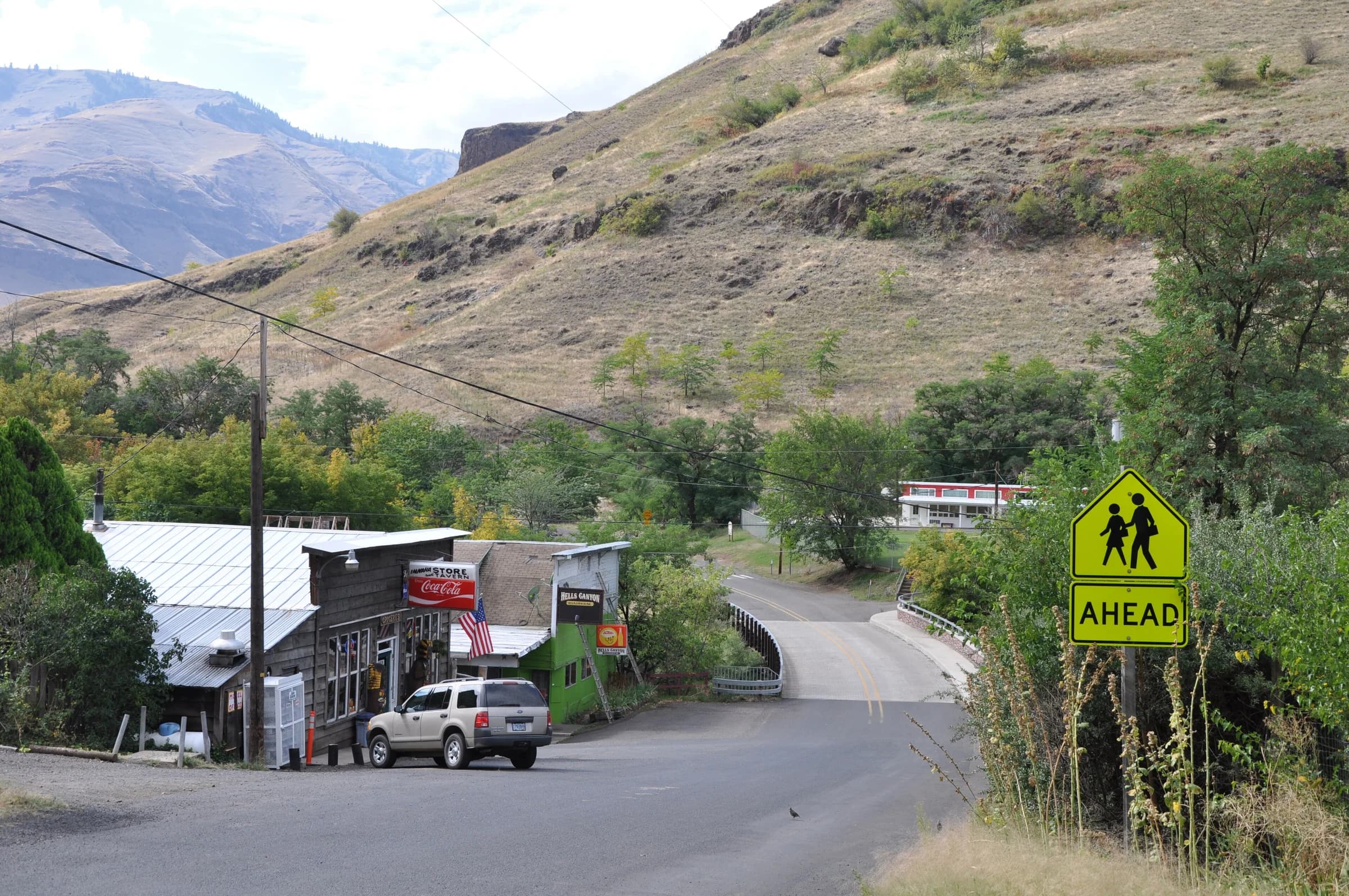
Imnaha: distance and daily routines deserve a place alongside the valley towns.
Finetooth · 2010-09-18 · CC BY-SA 3.0 · Image & source ↗
04 · A story to follow

The people who keep a place going

Reported experience

What people here have said. The hospital’s 2025 assessment ranked “Social Determinants of Health, especially housing” first among ten needs; 73.6 percent of its informants rated access to care a moderate or major problem 14. In the 2021 survey, 69 percent agreed they had “enough medical and dental providers”; 41 percent agreed their community had “many residents struggling with substance abuse,” 27 percent with mental illness 4. Fifty-eight percent agreed “child care is hard to find”; one respondent wrote: “Once we leave our homes, we have no cell service until we get to town, which is a two-hour drive” 4. After the August 2022 hailstorm, Wallowa’s mayor put the town at about 400 homes on city sewer and water and said “every home was damaged” 32.

Documentary records

What the records show. In the 2009 survey, a third of 98 children 13 and under were in no non-parental care, 14 percent in a center — too few, the report said, to generalize 1. Early in the pandemic the hospital worked with an existing provider to open child care for staff families, room for about sixteen; operator and present status are not established 37. In 2018–2022 estimates, 81.5 percent of households had a broadband subscription, against 90.5 percent statewide 15. After the hail, the Emergency Board approved $2 million on September 23, 2022, and the next shortage was contractors 33. A case manager served 324 households through April 2023; 30 cases closed 34. A February 2024 microgrid study, following the county energy plan adopted in December 2023, modelled ten scenarios at $1.82 million to $158.49 million and said its goal “was not to achieve investment-grade costs or construction documentation” 35.

Open questions

What is still unknown. No source counts child care slots or providers; the 2024 regional assessment reports zero center-based preschool slots for the county, on 2022 data 15. Nothing in the microgrid plan is funded or built; the program’s site places it “in progress of the planning phase” and the only priced next step is a $300 utility review 36, 35. How many hail-damaged homes were fully repaired is unrecorded.

Questions to carry with you
  • What happens here when the power, road or usual support is unavailable?
  • Whose unpaid work would you like more people to understand?
Add your experience or hopes ↗
Part three · Making and deciding
Joseph’s Main Street, a place to begin following the connections between work and community.
Visitor7 · 2013-04-09 · CC BY-SA 3.0 · Image & source ↗
05 · A story to follow

What we make, and what we pass on

Reported experience

What people here have said. The 2021 analysis said the county “still produces 60–70 million board feet of lumber each year, primarily from private lands,” though nothing replaced timber at its peak 2. A caster who helped start Joseph’s foundry recalls being told “You’re a tooler!” 42. Maxville’s heritage center writes that Black families there “lived in segregated housing, attended segregated schools, and played on a segregated baseball team—but they worked side by side with white workers felling timber” 39.

Documentary records

What the records show. Maxville held about 400 people, 40 to 60 of them African American, before Bowman-Hicks closed in 1933 39. Its one surviving log office was restored to its original site in 2024, the year the townsite joined the National Register 38; the center’s index names six oral histories 40. Valley Bronze has cast in Joseph since 1982 41; the Joseph Timber sawmill closed in 2002 43. In 2025, 29 home-building firms employed 66 people 9.

Open questions

What is still unknown. Manufacturing’s 2025 job count is suppressed; only 14 establishments are visible 9. Valley Bronze publishes neither an employee count nor an apprenticeship; Parks Bronze has no live site to check 41, 42. Which trades a young person could enter locally, and at what wage, no table shows.

Questions to carry with you
  • Who taught you, and what did they teach that no manual could?
  • What would an apprentice need besides training to build a life here?
Add your experience or hopes ↗
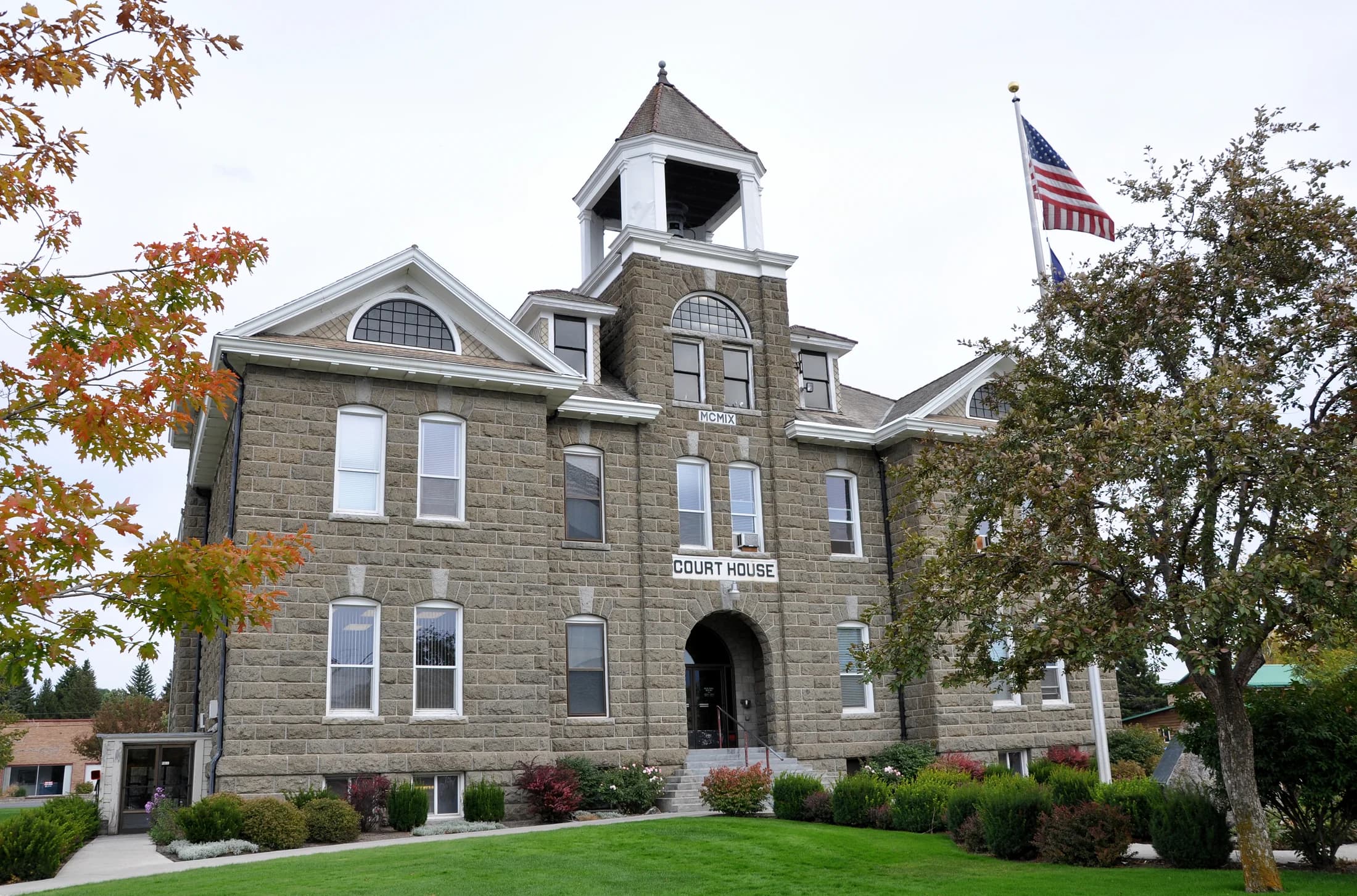
The Wallowa County Courthouse. Public decisions can be followed through records and participants’ accounts.
Finetooth · 2010-09-17 · CC BY-SA 3.0 · Image & source ↗
06 · A story to follow

Who gets to shape the future?

Reported experience

What people here have said. In 2009, 18-to-28-year-olds were 8 percent of the population and 3 percent of meeting attendees 1. In 2021, 57 percent agreed people “come together to solve community problems” and 37 percent that people “welcome newcomers” 4. The 2021 analysis conceded pandemic rules “prevented large public gatherings and thus limited the public engagement possible” 2. A columnist and longtime resident wrote in 2023: “This community still has problems, but we are rich in the reserves it takes to solve problems” 47.

Documentary records

What the records show. Voters rejected a county library district on May 15, 2018, 1,979 to 1,102 44; by August literacy kits had gone to Building Healthy Families, librarians and the Imnaha and Troy schools were asking to select books, and storage in the Wallowa Resources basement was under discussion 45. The East Moraine purchase drew $3.5 million in federal forest-legacy funds, $1 million from state parks, $300,000 from the Nez Perce Tribe and more than $1.1 million from individuals 12. In May 2026, with 61 percent turnout, voters passed a measure to end the county’s participation in the Greater Idaho movement, on unofficial results 46.

Open questions

What is still unknown. The only retrieved source preserving the 2006 vision gives no participant count — the original was not obtained — and a repeated figure of 720 does not appear there 1. The 2009 survey aimed for 541 returns and got 276 1; the 2021 survey had 86 4. Whether the indicators were re-measured, and whether the energy plan’s seven-person review panel was seated, are open 36.

Questions to carry with you
  • When did you feel heard in a local decision? When did you not?
  • What would you use to judge whether a change helped this community?
Add your experience or hopes ↗

Possibilities, not promises

Each idea below starts from a documented local need; none is funded, forecast or agreed.

Tools for working land

Ranching + ecology + maps + equipment repair

Start from the collars on East Moraine cattle since 2024, after the 2022 plan costed the cross-fencing its rotation needed at $75,000 26, 27. Test a full season on a private operation — cost per head, failures, welfare, dead ground — against the research center’s caution that it “isn’t a replacement for animal husbandry or ranch management practices” 28.

Making and repairing locally

Craft + design + fabrication + teaching

Start from six commercial spaces in an Enterprise building being rehabilitated 17, 18, 29 home-building firms with 66 workers among them — about two apiece, by arithmetic 9 — and a foundry seeking “foundrymen, welders, or fabricators” 41. Before proposing machinery, ask those shops about customers, workspace, succession and apprentice pay.

Keeping essentials running

Electrical work + controls + maintenance + emergency planning

Start from a plan that knows its limits: circuits near their daytime-load ceilings, a biomass plant too large for the building beside it, a first step costing $300 35. The 2022 hail showed money can arrive before the trades to spend it 33. Name who would operate a system and what it could power in an outage.

What would a useful tool help you do? ↗
Original recordings · Connected to this page

Hear the people inside the story.

All recordings
Your words, with your permission

Many ways to call a place home.

No responses to these questions have been published yet. The sources and the films on this page are existing work, with their own authors and dates.

Share an experience

What makes this home?

Tell us about an ordinary moment that explains what makes this place home for you.

Respond in your own words ↗
Imagine & reflect

A life here in 2046

Imagine an ordinary day here in 2046 after twenty good years. Who is able to live here, and what made that possible?

Respond in your own words ↗
Imagine & reflect

Coming home

What does being at home in Wallowa country mean to you, and what would make it easier for you or the next generation to be here?

Respond in your own words ↗
Imagine & reflect

The work behind the view

What work on the land do you want the next generation to be able to continue, and what would need to change to make that possible?

Respond in your own words ↗
Share an experience

When neighbors show up

Tell us about a time someone here helped you, or a time the help you needed was hard to find. Share only details you want made public.

Respond in your own words ↗
Imagine & reflect

Skills worth passing on

What do you know how to make, repair, grow or do that you would like someone younger to learn? What would help them earn a living doing it here?

Respond in your own words ↗
Share an experience

A decision that changed a place

Describe a local decision you lived through. Who had a say, what changed, and what should a future decision do differently?

Respond in your own words ↗
Imagine & reflect

Useful tools, on your terms

What part of your work or daily life could a better tool help with? What would you want to keep in human hands?

Respond in your own words ↗

What happens next

1. Your note is saved privately. Nothing is public yet.

2. The editor reads it. Your private link always shows the status.

3. If the wording needs to change, you approve the new wording first, from that link. A voice note is transcribed by the editor and the transcript comes to you the same way.

4. If it is approved, it is published with the credit you chose. You can correct or withdraw it at any time.

Two memories of one place

Both can be published, each with its author, its date and its own wording. Where they differ, the atlas says so and notes what independent evidence establishes; it does not rewrite either account.

If you lose your private link

Write to edan@portlandciviclab.org from the email you gave. Once the editor has confirmed it is you, the editor can take the account down on your instruction or issue a new link. Corrections need the link or a new submission.

Follow the evidence

Sources

Numbers in the text refer to the sources below; “p.” means printed page.

  1. Vital Wallowa Indicator Project: 2009 Baseline Assessment Report
    Oregon State University Extension Service and Rural Studies Program, with Wallowa Resources, NEOEDD and The Ford Institute for Community Building · February 2010; data vintages 2000–2009
    Printed pp.4, 9, 20–21, 32, 34–36, 42–43, 49–55, 58–60, 62

    Reprints the 2006 vision (facilitated by NCSU faculty, guided by the Wallowa County Economic Action Team; no participant count) and takes a 2009 baseline on 26 indicators; survey n=276, ±5.8%. Farmland share is 2007, national forest share 2009. The indicators were developed ‘relying on the input from the community forums and the 2006 vision statement’ (p.4). Indicator 6 percentages rest on 57 parents reporting on 98 children; the report says the sample is not adequate for generalization.

    Checked 2026-09-14
  2. Economic Opportunity Analysis: 2021 — Wallowa County
    Wallowa County Board of Commissioners; prepared by PARC Resources with Oregon DLCD and Business Oregon · 2021 (TAC meetings June 2020–April 2021)
    Printed pp.2, 10, 14–15, 25, 28, 70, 74

    Planning document; its vision was drafted by a six-member committee under pandemic limits. The p.25 lumber figure is a typo; p.28 governs. The two transfer-payment shares on p.15 are the document’s own unreconciled conflict. Table 17 rent figures are undated.

    Checked 2026-09-14
  3. Community Needs Assessment
    Northeast Oregon Economic Development District · May 2021; interviews January–early March 2021
    Printed p.14 (Built & Natural Environments); p.17 (Economic Development challenges)

    Regional findings for Baker, Union and Wallowa counties from 70+ volunteer interviews; not disaggregated by county.

    Checked 2026-09-14
  4. Oregon Voices Data Summary: Wallowa County
    The Ford Family Foundation, with ECONorthwest and PSU Regional Research Institute · April 2023; fielded from summer 2021
    Pages 1–7

    86 respondents (77 random-household, 9 engagement), average age 63, eight in ten homeowners; the summary publishes no renter count. Unweighted, no margin of error published.

    Checked 2026-09-14
  5. Coordinated Population Forecast for Wallowa County, its Urban Growth Boundaries (UGB), and Area Outside UGBs 2023–2073
    Population Research Center, Portland State University, for the Oregon Population Forecast Program (Marquez, Sharygin, Loftus, Alkitkat, Montcho, Swanson and Wilde, 2023) · June 25, 2023
    Pp.5, 9–11, 14, 17, 18

    Current official forecast (Cycle 3, 2022–2025). Report distributed by the program as a PDF (direct copy: https://drive.google.com/file/d/1lOjdiv5V22XFYFSXLZ2r5LDCtvC2Digr/view). Table 2 is by urban growth boundary, not incorporated city limits. Five-year county totals cited are column sums of Table 5, validated against the report’s printed 2020, 2030 and 2040 figures.

    Checked 2026-09-14
  6. Decennial Census population counts, Wallowa County, Oregon: 2000, 2010, 2020
    U.S. Census Bureau · April 1 counts, 2000, 2010, 2020
    Tables DECENNIALSF12000.P001 (P001001), DECENNIALSF12010.P1, DECENNIALPL2020.P1 (P1_001N), geography 0500000US41063

    County totals 7,226 / 7,008 / 7,391; they match the PSU report’s Table 1.

    Checked 2026-09-14
  7. American Community Survey 5-Year Estimates 2020–2024, Wallowa County: Data Profiles DP03, DP04, DP05 and Detailed Table B25004
    U.S. Census Bureau · 2020–2024 five-year estimates
    DP04 total, occupied and vacant units and median value; B25004_006E seasonal vacancy (±130); DP03_0062E median household income

    Five-year averages, not point-in-time counts. The price-to-income ratio (5.9) and the seasonal share of stock (14.5%) are arithmetic on the estimates.

    Checked 2026-09-14
  8. Fall Membership Report 2025-26 (with 2015-16 for comparison)
    Oregon Department of Education · October 2025 count; file posted February 12, 2026
    District worksheets for October 2015 and October 2025

    Four-district totals 857 (October 2015) and 878 (October 2025) are our sums of the district rows (Enterprise 404/425, Joseph 242/249, Wallowa 209/199, Troy 2/5); the files print no county total. The 2015–16 worksheet is keyed on attending district, the 2025–26 worksheet on district of enrollment. The 2009–10 figure (872) is from the 2021 EOA’s Table 2, a separate tabulation of ODE data.

    Checked 2026-09-14
  9. Quarterly Census of Employment and Wages, annual averages, Wallowa County (area 41063), 2022–2025
    U.S. Bureau of Labor Statistics · 2025 annual averages (2022–2024 also cited)
    Rows agglvl 70 (county total), 71 (by ownership), 74–78 (by NAICS); disclosure_code N marks suppressed cells

    Covered payroll jobs only; excludes proprietors and the self-employed. Suppressed cells are unknown, not zero. NAICS 236115: 66 jobs across 29 establishments in 2025; ‘about two apiece’ is arithmetic.

    Checked 2026-09-14
  10. Quarterly Census of Employment and Wages, annual averages, Wallowa County (area 41063), 2015
    U.S. Bureau of Labor Statistics · 2015 annual averages
    Rows agglvl 70 and 71

    NAICS 2012 basis; county totals comparable with 2025, industry detail only loosely. Earliest year this endpoint serves is 2014.

    Checked 2026-09-14
  11. July 2026 Employment and Unemployment in Oregon’s Counties
    Oregon Employment Department · August 25, 2026
    P.2, second paragraph

    Total nonfarm payroll change by place of work; the release does not attribute the county’s 8.3% loss to any employer.

    Checked 2026-09-14
  12. 1,791 Acres of Wallowa Lake’s East Moraine Acquired for Wallowa County
    Wallowa Land Trust · January 21, 2020
    Headline; ‘Push to protect moraine receives broad support’; ‘A Community Legacy’

    Press release by the purchasing partnership; funding stack and acreage as stated. Acreage differs from later documents (1,820; 1,824).

    Checked 2026-09-14
  13. Final Hurdle Cleared to Permanently Protect East Moraine Community Forest
    Wallowa Land Trust · February 8, 2023 (signing January 26, 2023)
    Paragraphs 2–3; Katy Nesbitt quotation

    Organization’s account of the signed easement, co-held with the Oregon Department of Forestry; gives 1,824 acres.

    Checked 2026-09-14
  14. Wallowa Memorial Hospital 2025 Community Health Needs Assessment — Executive Summary
    Wallowa Memorial Hospital and partners; hosted by OHSU Oregon Office of Rural Health · 2025 (PDF created November 26, 2025)
    ‘Community Priorities’; ‘Aging Population’; ‘Outmigration for Care’; ‘Biggest Gaps in Service’

    Four-page summary; cites no years, sources or sample sizes for its statistics. Priority ranking came from providers and community leaders, not a resident vote.

    Checked 2026-09-14
  15. 2024 Community Health Assessment Report
    Eastern Oregon Coordinated Care Organization · 2024 (data accessed November 2024; child care access figure 2019 vintage)
    Printed pp.70–71; child care access figure 2019, broadband 2018–2022, preschool slots 2022

    Indicator tables for Wallowa; mixed vintages on one page. Child care access (17% vs 23%) is from the 2019 Oregon Child Care Desert report; broadband (81.5% vs 90.5%) is ACS S2801 2018–2022; zero center-based preschool slots is 2022 data.

    Checked 2026-09-14
  16. Governor focuses on housing issues in Wallowa County visit
    Wallowa County Chieftain (Bill Bradshaw and Mike McInally); served at lagrandeobserver.com · May 6, 2023 (meeting May 5, 2023)
    Body text; Nels Gabbert quotation

    Newspaper report; Nels Gabbert is identified as a Wallowa Resources advisory board member and a key player with Working Homes, which the article describes as a nonprofit created by Wallowa Resources. He is recorded speaking at a meeting the governor attended, not addressing her directly. The wallowa.com URL for this article returns 404.

    Checked 2026-09-14
  17. Enterprise projects: EM&M building
    Working Homes LLC · Undated page; acquisition July 2024
    EM&M Building, paragraphs 1–3

    Owner’s own account of purpose, not an outcome for tenants; the page does not establish nonprofit status (the owner is recorded here as Working Homes LLC).

    Checked 2026-09-14
  18. Working Homes advances housing, building preservation projects in Wallowa County
    Elkhorn Media Group (Shannon Weidemann) · September 2, 2026
    EM&M paragraphs and ‘Current upgrades’ list

    Distinguishes completed, underway and anticipated work; no tenant interviews.

    Checked 2026-09-14
  19. Interdependence in Wallowa County (from the 2020 TOP report ‘Cornerstones: Economic Mobility and Belonging in Oregon’)
    Oregon Community Foundation · 2020 report; page undated; underlying data 2017–2020
    Section ‘A community goal to support youth with economic opportunities’; endnote 10 (Opportunity Atlas)

    The two-in-three figure is Opportunity Atlas data for children born 1978–1983 and describes where that cohort lived as adults, i.e. decisions made in the 1990s–2000s; 2020 is the report’s publication year, not the measurement date.

    Checked 2026-09-14
  20. Strategic Planning — Nez Perce Wal’áwa Homeland 100-year strategic plan
    Nez Perce Wallowa Homeland (nonprofit) · Adopted 2023
    ‘Our Story’ (1989 date, 323 acres); pull quote attributed ‘Taz Conner, 1994’ between ‘Our Guiding Values’ and ‘Our Mission’; Goal ‘Reciprocal Relationships’ (10-, 30-, 100-year horizons; ‘address barriers to return’); funders list

    A nonprofit’s stated intentions, distinct from the Nez Perce, Umatilla and Colville tribal governments, which it lists as contributors.

    Checked 2026-09-14
  21. About Us — Nez Perce Wallowa Homeland
    Nez Perce Wallowa Homeland (nonprofit) · Undated page; retrieved September 14, 2026
    ‘Who We Are’ (self-description); ‘Our Work’; ‘Organizational History’

    Self-description as ‘a landback nonprofit—not a tribal government’; dates the first Tamkaliks to 1989, while the Tamkaliks page says 1990.

    Checked 2026-09-14
  22. History — Nez Perce Tribe
    Nez Perce Tribe · Undated page; retrieved September 14, 2026
    ‘Treaties’ section

    The Tribe’s own account of the 1855 and 1863 treaties and reserved off-reservation rights; does not discuss the Wallowa country specifically.

    Checked 2026-09-14
  23. Fisheries Resources Management — Nez Perce Tribe
    Nez Perce Tribe, Department of Fisheries Resources Management · Undated page; retrieved September 14, 2026
    Opening paragraph; ‘Production Division’ project list (Lostine River Supplementation Project)

    Establishes present-tense program presence in the Wallowa basin; no project detail or dates.

    Checked 2026-09-14
  24. Restored Coho Salmon Run Supports Tribal, Sport Fisheries in Northeast Oregon for First Time in Decades
    NOAA Fisheries, West Coast Region · November 13, 2020
    Paragraphs 2–3

    The 5,000 figure counts fish past Bonneville Dam, not fish in the Lostine; credits the Umatilla and Nez Perce tribes and ODFW.

    Checked 2026-09-14
  25. Snake River Basin Adult Chinook Salmon and Steelhead Monitoring 2021 Annual Report
    Nez Perce Tribe, Department of Fisheries Resources Management (copy hosted by U.S. Fish and Wildlife Service) · August 1, 2022 (spawn year 2021)
    P.4 (weir operation dates); p.26, Table 3 (Lostine River tributary escapement 914, 95% CI 746–1,164)

    Combines natural- and hatchery-origin fish; most recent year retrieved.

    Checked 2026-09-14
  26. East Moraine Community Forest Multi-Use Management Plan
    Wallowa County / Wallowa Lake Moraines Partnership · July 2022 (PDF created August 25, 2022)
    Pp.41–46

    Gives ‘approximately 1,820’ acres. The 80-pair figure is a committee recommendation for one pasture and two months, not a recorded stocking change; no source records the stocking actually run. Contains no mention of virtual fencing, which enters the record with the February 2023 easement release.

    Checked 2026-09-14
  27. How virtual fencing could change rangeland management
    Oregon Public Broadcasting, Think Out Loud (Gemma DiCarlo; host Dave Miller) · September 3, 2024 (updated September 10, 2024)
    Transcript; Pete Schreder on costs, training and the East Moraine pilot

    Computer-generated, volunteer-edited transcript; cost figures are the Extension agent’s spoken estimates, not a costed study. Trial results not yet reported.

    Checked 2026-09-14
  28. Virtual Fence Technology — Eastern Oregon Agricultural Research Center
    Oregon State University, College of Agricultural Sciences · Undated page; describes a January 29, 2025 workshop
    Introductory text; blurb under ‘Part 3 – Up and Running’

    Research-center video series and workshop notes; no cost figures on the page.

    Checked 2026-09-14
  29. Where’s the grass-fed beef?
    Cory Carman, published by PERC (Property and Environment Research Center) · February 24, 2011
    Paragraphs 5–7

    First-person, unaudited cost figure from a Wallowa ranch; the publisher is a free-market policy organization.

    Checked 2026-09-14
  30. About Us — Carman Ranch
    Carman Ranch Direct · Undated page; retrieved September 14, 2026
    ‘Ways To Buy’ (Cow Share; Wholesale)

    Producer’s own description of channels; wholesale beef is processed in Brownsville, shares by a local butcher.

    Checked 2026-09-14
  31. Forests — Wallowa Resources
    Wallowa Resources · Page carries ‘2024 metrics’; retrieved September 14, 2026
    ‘All-Lands Approach to Forest Health’, 2024 metrics block

    Self-reported organizational metrics; ‘423 landowners’ is the Wallowa County figure, ‘50 forest management plans / 30,093 acres’ is northeast Oregon (Wallowa, Baker, Union, Umatilla); unclear whether acreage figures are annual or cumulative.

    Checked 2026-09-14
  32. Eastern Oregon town damaged by hail storm recovers together
    Oregon Public Broadcasting, Think Out Loud (Sage Van Wing; host Dave Miller interviewing Mayor Gary Hulse) · August 25, 2022
    Transcript; Hulse on the number of homes damaged

    Mayor’s estimate two weeks after the storm, using homes on city sewer and water as the denominator; machine transcript.

    Checked 2026-09-14
  33. State sends millions to Eastern Oregon to deal with storm damage, pollution
    Oregon Public Broadcasting (Antonio Sierra) · September 29, 2022 (Emergency Board meeting September 23, 2022)
    Opening Wallowa section, before ‘Nitrates and flooding’

    Approved funding is spending authority, not completed repairs; reports the contractor shortage.

    Checked 2026-09-14
  34. Honor UMCOR Sunday & OR-ID Disaster Response on March 15
    Oregon-Idaho Annual Conference, The United Methodist Church · February 18, 2026 (grant period October 2022–April 2023)
    Bulleted list ‘OR-ID Conference UMCOR response by the numbers’, fourth bullet

    Grantmaker’s retrospective; 324 households served and 30 cases closed are service counts, not repaired homes.

    Checked 2026-09-14
  35. Wallowa County Microgrid Plan (filed as public testimony document 122821 on HB 2066)
    ProtoGen, Inc. for Wallowa Resources Community Energy Program; filed by Wallowa County (John Hillock) · Plan dated February 2024; filed February 6, 2025
    Pp.1, 42–44

    Modelled scenarios only; states it is not construction-ready. Every page carries a ‘Confidential’ footer despite being public testimony. The study was a separate DOE/ODOE-funded effort contracted through Idaho National Laboratory, prepared alongside (not for) the county energy plan adopted December 20, 2023.

    Checked 2026-09-14
  36. Community Energy Plan and Microgrid pages — Wallowa Resources Community Energy Program
    Wallowa Resources Community Energy Program · Undated pages; latest dated item November 2023; microgrid one-pager coded July 2024; retrieved September 14, 2026
    ‘Community Review Panel’ (energy-plan page); opening status sentence (microgrid page)

    Program describes the microgrid as in the planning phase and the review panel prospectively; neither seating nor construction is documented.

    Checked 2026-09-14
  37. Workforce Introduction
    Robert Barclay et al., Flex Monitoring Team · March 2025
    P.5, opening Wallowa Memorial paragraph

    Short case study; opening date, operator and present status of the child care are not stated.

    Checked 2026-09-14
  38. Maxville Milestones
    Maxville Heritage Interpretive Center · Timeline entries 2008–2026; retrieved September 14, 2026
    Entries under ‘2015’, ‘2018’, ‘2023’, ‘2024’

    Organization’s own timeline; states the log office was restored to its original Maxville site in 2024, not relocated to the town of Wallowa.

    Checked 2026-09-14
  39. Our Story — ‘Breathing Life Into A Ghost Town’
    Maxville Heritage Interpretive Center · Undated page; references 2012; retrieved September 14, 2026
    Paragraphs 3–8 (population, Bowman-Hicks, segregation, 1933 closure)

    Interpretive narrative by a descendant-founded organization; its 1924–1933 heyday dates differ from the 2023 centennial on the milestones page.

    Checked 2026-09-14
  40. Maxville Collections
    Maxville Heritage Interpretive Center · Collection index; retrieved September 14, 2026
    Video Collection and Oral History Collection blocks

    Index of six named oral histories; item dates shown are CMS republication dates, not recording dates. Permissions must be checked per item.

    Checked 2026-09-14
  41. About — Valley Bronze of Oregon
    Valley Bronze of Oregon · Undated; site footer © 2025; retrieved September 14, 2026
    ‘Our History’; ‘Careers With Us’

    Company self-description; no current employee count or apprenticeship program is published.

    Checked 2026-09-14
  42. Steve Parks — Oregon Culture Keepers Roster
    Oregon Folklife Network, University of Oregon · Undated profile; retrieved September 14, 2026
    ‘Bio’ section

    Folklife profile; substitute for the Parks Bronze company site, whose domain is now parked.

    Checked 2026-09-14
  43. Three minutes with … Justin Doherty
    Wallowa County Chieftain, via Historic Oregon Newspapers (University of Oregon Libraries) · February 7, 2018
    Page A9, headed Public Works, City of Joseph

    Single worker interview dating the Joseph Timber closure to 2002; roles refer to the interview date.

    Checked 2026-09-14
  44. Library district fails
    Wallowa County Chieftain (Paul Wahl), via Historic Oregon Newspapers · May 23, 2018 (vote May 15, 2018)
    Page A1, paragraphs 2–6

    Contemporary report of unofficial results for Measure 32-41; not a certified canvass.

    Checked 2026-09-14
  45. Books, continued from Page A1
    Wallowa County Chieftain, via Historic Oregon Newspapers · August 8, 2018
    Page A9, ‘BOOKS’ continuation

    Distinguishes completed transfers from proposed placements: only the literacy-kit transfer to Building Healthy Families is reported as done; the Imnaha and Troy school selections were requests, and the Wallowa Resources basement was ‘space … we may be able to use’. The article gives no organizational status for either body. The A1 opening was not retrieved.

    Checked 2026-09-14
  46. 3 years after joining the Greater Idaho cause, Wallowa County votes to stop talking about it
    Oregon Public Broadcasting (Antonio Sierra) · May 21–22, 2026 (URL path May 21; page shows May 22)
    Body text

    61% is turnout, not the measure’s margin, which the article describes only as a landslide.

    Checked 2026-09-14
  47. Rich Wandschneider: A ‘greater’ — and wealthier — Wallowa County
    Wallowa County Chieftain (opinion column) · May 17, 2023
    Body text

    Signed opinion by a longtime resident; its population and enrollment figures are unsourced and not used here.

    Checked 2026-09-14
  48. Tamkaliks Celebration — Nez Perce Wallowa Homeland
    Nez Perce Wallowa Homeland (nonprofit) · Undated page carrying the 2026 schedule (July 17–19, 2026); retrieved September 14, 2026
    Undated page with 2026 schedule; section “Tamkaliks: Beginnings”

    Dates the first gathering to 1990, while the strategic plan and About page say 1989; the organization’s Foundation Document, which would settle it, is not published online. The July 17–19, 2026 dates are the announced schedule, not a record of the event held.

    Checked 2026-09-14