Chinese miners’ efforts to obtain justice, a petition to restrict return, and the people who kept local papers show that an archive is not a neutral pile of facts. Its silences have histories too.
Editorial synthesis · 5 minute read · 9 sources
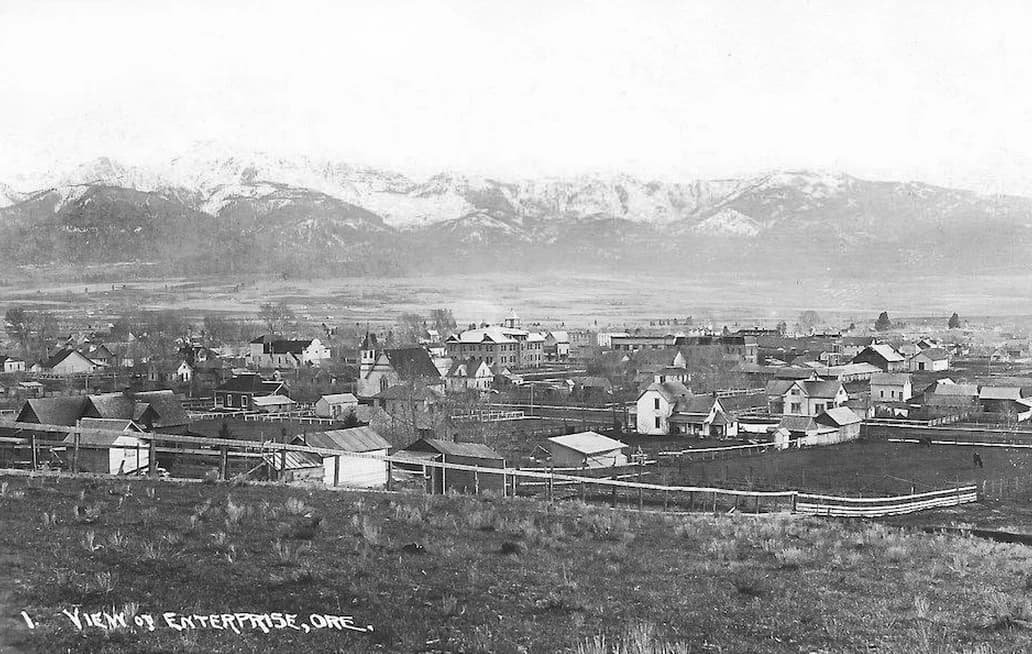
Enterprise in a postcard circa 1912. This photograph was made after the 1888 trial discussed below. Unknown photographer; digital restoration by Tim Davenport · circa 1912 · Public domain · Image & source ↗
In this story 6 sections
An Enterprise trial with no punishment
In May 1887, Chinese miners were murdered near Deep Creek on the Snake River. Historian Greg Nokes distinguishes an initial report of ten victims from evidence suggesting as many as thirty-four. The uncertainty is part of the surviving record; it should not erase the scale of the crime.
The miners’ employer, the Sam Yup Company, pursued an investigation. Lee Loi helped seek answers, and the company hired investigator Joseph K. Vincent. The Chinese consulate also sought action. The victims’ community was not simply waiting for someone else to notice.
Six men were indicted in 1888. Three fled, and three were acquitted after a trial in Enterprise. No one was punished. Nokes describes court records found in a county safe in 1995 and a memorial dedicated in 2012. The later discovery does not, by itself, prove deliberate concealment.
Putting the efforts to obtain justice near the center changes the story. It becomes an account of people seeking accountability and institutions failing to deliver it, rather than only a mystery rediscovered by later historians.
A court file can establish that a prosecution occurred without establishing that justice was done. An acquittal is a legal outcome; it is not an explanation of every event that preceded it. Testimony can preserve detail while also reflecting a witness’s interests or the questions that officials chose to ask.
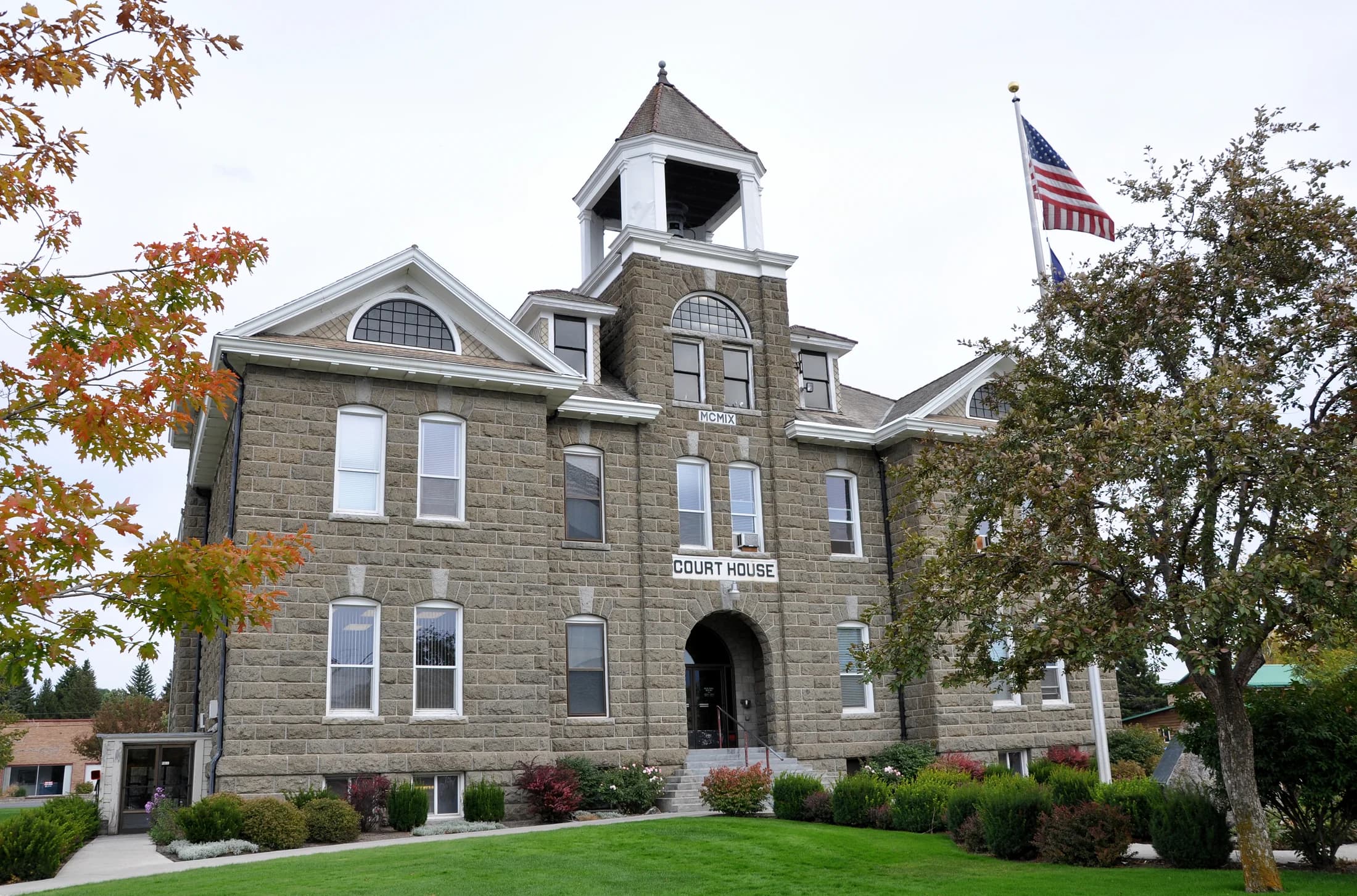
Place identification requires equal care. The present Wallowa County Courthouse dates to 1909, after the 1888 trial. A photograph of that building is therefore not a photograph of the trial’s setting. The distinction prevents a familiar landmark from giving an unsupported claim the appearance of certainty.
For the miners, the absence of full biographies is itself a limit on what can presently be told. Names, family ties, and journeys should be recovered from evidence where possible; plausible details cannot stand in for lives the record has failed to preserve.
The Wallowa County Courthouse in Enterprise, photographed in September 2010. Built in 1909, this courthouse postdates the 1888 trial; it is not the trial’s setting. Finetooth · 2010-09-17 · CC BY-SA 3.0 · Image & source ↗
A petition and a photograph ask different questions
Marilyn Hulse’s account of a 1901 petition describes an effort to restrict tribal return to the valley. Her account of the Benjamin Curtis photographs documents later Nez Perce visits in the lower valley. One source records a desire to exclude; the other offers evidence of continuing presence.
Neither cancels the other. Together they show why an official request, an imposed boundary, and people’s actual movements cannot be treated as the same thing. An institution can try to control access without extinguishing a relationship to a place.
The original petition and the individual photographs still deserve examination in their own context. A later caption may carry an identification that the photographer did not record; a retrospective may summarize a response whose wording matters. The question is not only whether a source exists, but what part of the claim it actually supports.
Rich Wandschneider’s accounts of local archival work make the people behind the collections visible. His 2012 essay describes Grace Bartlett’s accumulated research and visits by archivists. His 2026 writing describes the Wallowa History Center and the work of people including Mary Ann Burrows, Marilyn Hulse, and Linda Bauch.
A collection is the result of finding, keeping, arranging, and explaining material. Those tasks shape what later researchers can discover. A letter saved in one household and discarded in another can change the apparent balance of the historical record without reflecting the relative importance of the two lives.
This makes preservation a form of public work. It also gives readers a reason to ask how a collection was assembled: who donated, who described the material, which communities were approached, and which kinds of records were too difficult or costly to retain.
An archive can also begin when someone realizes how much has gone unsaid. In a 2017 Oregon Humanities profile by S. Renee Mitchell and Joe Whittle, Gwen Trice described learning only in 2003 that her father, Lafayette “Lucky” Trice, had been part of Maxville’s logging history. Her training in theater and filmmaking became tools for finding out more.
She visited people, asked questions and recorded hours of interviews. The Maxville Heritage Interpretive Center opened as a nonprofit in 2008. The profile describes descendants bringing artifacts and reminiscences, and Trice interviewing Alvin Marsh, the last living Black Maxville logger identified in the account, before his death in 2009.
This was a race against the loss of people as well as objects. The resulting collection changed what later readers could ask about the county: working lives that barely registered in a familiar town history now had speakers, family connections and material traces. Preservation began with a daughter’s curiosity and became a means for many families to enter the record.
The Wallowa History Center’s research guide points toward newspaper collections and the Enterprise Library portal. Lostine’s event archive offers a different scale of record, with notices about civic business and everyday activities. Such material can show how a place functioned between the events later chosen as turning points.
An advertisement establishes that someone offered a product or service at a particular time; it does not prove every claim in the advertisement. A meeting notice establishes an intention to meet; minutes or another account are needed to establish what happened. Reading ordinary records closely can add detail without turning every mention into a settled fact.
The county’s history becomes deeper when sources are read against one another: a court outcome against efforts to obtain justice, a petition against later photographs, a public anniversary against household papers. The aim is not a single flawless narrative. It is a story whose evidence remains visible enough for another person to question, correct, and extend.
Oregon Humanities · S. Renee Mitchell and Joe Whittle · Accessed 2026-09-13
August 24, 2017. Reported profile with interviews and documentary photographs. Locator: Trice’s 2003 discovery, recorded interviews, the 2008 center, and encounter with Alvin Marsh. Images remain with the publisher; no republication permission inferred.