The price of staying
In the first week of October 2026 the atlas sat down with about twenty people in Enterprise, Joseph and Wallowa, and talked by phone with three more in the week after. Nearly all of them named the same first problem: a home that someone who works here can afford. Nearly all of them attached the same condition: keep the place as it is. The distance between those two sentences is most of what Wallowa County is arguing about, and most of what it will decide in the next twenty years.
An atlas reading of about twenty conversations and the public record. Ideas from the conversations appear without names; a name appears only where its owner approved the exact words. Nothing said about a neighbor, an employee or a tenant is here. Numbers in brackets refer to the sources at the end.
Nineteen of twenty
On Sunday, October 4, 2026, in Cloverleaf Hall on the fairgrounds at Enterprise, the candidates for the county’s local offices sat in a row before their neighbors. The forum was sponsored by the Chamber of Commerce, the Stockgrowers and the Rotary Club, which is to say by the three institutions that have sponsored most public things in this county for a century. There were twenty local seats on the sheet handed out at the door. Nineteen of them had one candidate. Every candidate who spoke named housing for the people who work here as the thing that had to be fixed, and the questions from the floor asked for it “without altering our rural character.” Nobody mentioned a fee on second homes, the lodging tax, or tourism 1.
That is the county in two sentences, and the week of conversations that followed kept producing them. Twelve or more of about twenty people, asked what the first problem was, said a home for the people who work here. Nearly all of them, in the same breath, said the place must stay as it is. Ten of them wanted the pace of change kept, and every one of those could name a decision the county had already made to keep it: a state airport left at Joseph with a runway too short for the jets a recruiter would want, a vision statement in 2006 that asked for “a County with no mega anything,” a ridge above the lake bought so that no one would build on it 1, 18, 19. Nine raised second homes without being asked. Seven said the same few hundred people run the fair, the festivals and the boards, and that they are tired. Six said that elders have nowhere to go. Six said, in one form or another, that the county lives on money decided somewhere else 1.
A word about who was heard, because it governs everything that follows. Most of the people were running an institution: the hospital, the schools, the land trust, the development district, the music alliance, a real-estate office, a coffeehouse, a restaurant, and the county itself. Few were under forty. The county’s conservative majority was heard mainly through its officials and through the forum. A working rancher, a renter speaking for himself, a second-home owner and anyone under thirty-five outside an institution were not heard, and the page says so where it matters. Three conversations about the Nez Perce homeland were had, and are being reviewed by the people they belong to; nothing from them appears here until they say so. What does appear is the ideas, counted by how many people raised them and set beside what the public record can show. No one is named unless they approved the exact words, and anything anyone said about a neighbor, an employee or a tenant was left out 1.
A county that holds its number
The county covers 3,146 square miles of land, more than the state of Delaware, and 1,171,213 acres of it, about 58 percent, belongs to the federal government, which pays no property tax on it 34, 35. On the rest live 7,391 people, by the 2020 count, which is 2.35 people to the square mile 6. It is the kind of arithmetic that people here do themselves, unprompted. One county official described the place as frontier country, culturally apart from the rest of Oregon, and nobody in a week of conversations disagreed 1.
What is remarkable about the number of people is how little it has moved. There were 7,102 people in the county in 1960, 6,247 in 1970, 7,273 in 1980, 6,911 in 1990, 7,226 in 2000, 7,008 in 2010 and 7,391 in 2020 8, 7, 6. Sixty-five years of boom and bust elsewhere in the West, the closing of the sawmills in the 1990s, the arrival of the bronze foundries, the internet and the second-home buyer, and the county ended with 289 more people than it had in 1960. The state’s official forecast expects it to stay there a while longer and then slip: 7,406 people in 2025, 7,184 in 2035, 6,717 in 2045 5.
About the same number of people for sixty-five years
Census counts since 1960 and the state’s official forecast to 2045.
The county has stayed between about 6,200 and 7,400 people since 1960. The forecast assumes 36 more people a year move in than move out from 2026 and expects deaths to outnumber births three to one by 2040; the forecast figures are the sum of its age table.
Sources: 1970 Census of Population, Volume 1, Part 39, Oregon: Table 9, Population and Land Area of Counties: 1970 and 1960, U.S. Census Bureau, 1973 (data as of April 1, 1970 and 1960); 2010 Census of Population and Housing, Population and Housing Unit Counts, Oregon (CPH-2-39): Table 4, Population and Housing Units: 1970 to 2010, U.S. Census Bureau, 2012; Decennial Census population counts, Wallowa County, Oregon: 2000, 2010, 2020, U.S. Census Bureau, April 1 counts, 2000, 2010, 2020; Coordinated Population Forecast for Wallowa County, its Urban Growth Boundaries (UGB), and Area Outside UGBs 2023–2073, Population Research Center, Portland State University, for the Oregon Population Forecast Program (Marquez, Sharygin, Loftus, Alkitkat, Montcho, Swanson and Wilde, 2023), June 25, 2023.
The numbers as a table
| People | |
|---|---|
| 1960 | 7,102 |
| 1970 | 6,247 |
| 1980 | 7,273 |
| 1990 | 6,911 |
| 2000 | 7,226 |
| 2010 | 7,008 |
| 2020 | 7,391 |
| 2025 (forecast) | 7,406 |
| 2035 (forecast) | 7,184 |
| 2045 (forecast) | 6,717 |
The number holds. The people inside it have changed. In 1970 the census counted 1,645 county residents in kindergarten through high school, among 6,247 people; one resident in four was a schoolchild 11. In October 2025 the four school districts enrolled 878 students among about 7,400 people, one in eight 9, 5. The number of homes went the other way. There were 2,821 housing units in the county in 1970 and about 4,349 now, which is to say that the county built more than 1,500 homes for roughly the same number of people 7, 2. Smaller households explain part of it. The 630 homes the census counts as vacant and “kept for seasonal or recreational use” explain another part 2.
People offered three explanations for the empty desks, and all three are true at once. The first is family size: the couples who arrive now, several people said, arrive without children, and the retirees arrive past the age of having them. The second is work: the jobs that supported families in their child-rearing years left with the mills. The third is choice: one estimate put about 300 children county-wide in home, private or online schooling, and families in the smaller towns drive their children to Enterprise for more courses, so that the county’s total enrollment held almost steady over fifteen years while Wallowa’s district lost a fifth of its students and Joseph’s gained 1, 10, 9.
The county’s enrollment held. The towns’ did not.
The county total barely moved in fifteen years, while Wallowa’s district lost a fifth of its students and Joseph’s gained. People in Wallowa gave three reasons: fewer families in their child-rearing years, more home schooling, and students transferring to Enterprise for more courses.
Sources: Economic Opportunity Analysis: 2021 — Wallowa County, Wallowa County Board of Commissioners; prepared by PARC Resources with Oregon DLCD and Business Oregon, 2021 (TAC meetings June 2020–April 2021); Fall Membership Report 2025-26 (with 2015-16 for comparison), Oregon Department of Education, October 2025 count; file posted February 12, 2026.
The numbers as a table
| 2009–10 | October 2025 | |
|---|---|---|
| Wallowa School District | 253 students | 199 students |
| Joseph School District | 215 students | 249 students |
| All four districts | 872 students | 878 students |
The age of the county is the consequence. In 2000, about 19 percent of residents were 65 or older. In 2020 it was 29 percent, against 18 percent for Oregon as a whole, and the state expects 35 percent by 2030 and “deaths to outnumber births 3 to 1” by 2040 5. The forecast does not predict collapse, because it assumes that 36 more people a year will move in than move out from 2026 on 5. That assumption is the whole county in one number. Who those 36 are, whether they bring children, and whether there is a house for them to buy or rent is the question under every other question on this page.
Why people come back was answered the same way by everyone who had done it or watched it: family nearby, a safe place to raise children, the schools, the country itself, and, since 2020, a job that can be done from anywhere with a connection. Why people leave was answered just as consistently: nothing to do, no one to marry, no house. More than one person observed that the returners who manage it arrive with equity from a house sold somewhere more expensive, and that a trailing retired parent is now more common than a trailing child 1. Both observations say the same thing. The county can hold its number without holding its young, and it has been doing exactly that.
The ledger
The county’s residents had a personal income of $509.3 million in 2024. Of that, $147.9 million, 29 percent, came as transfer payments, which is the government’s term for money that arrives without work being done for it: Social Security, Medicare, Medicaid, veterans’ benefits and the rest. Another $108.1 million, 21 percent, came as dividends, interest and rent. What was left, about half, was earned 12. Within the earnings, government employers, which in this county include the hospital district and the four school districts, paid $79.7 million, and farms paid $24.9 million 12.
Half of the county’s personal income does not come from a paycheck
Personal income of county residents in 2024, $509.3 million in all.
Transfer payments are money residents receive from government programs rather than from work. Within earnings, government employers, which here include the hospital district and the schools, paid $79.7 million and farms $24.9 million. The earnings figure is the remainder after the other two parts, by the atlas’s arithmetic.
Source: CAINC4: Personal income and employment by major component, Wallowa County, U.S. Bureau of Economic Analysis, 2024 estimates, released 2025.
The numbers as a table
| Millions of dollars, 2024 | Share | |
|---|---|---|
| Earnings from work, after social insurance contributions | $253.3m | 49.7% |
| Transfer payments: Social Security, Medicare, Medicaid and other program income | $147.9m | 29% |
| Dividends, interest and rent | $108.1m | 21.2% |
The people who run things here know this ledger by heart, and it was the sixth most common theme of the week without anyone being asked about it. The form it took was historical. The county was a timber county, and when the mills closed in the 1990s the harvest fell by about nine tenths, the schools lost about half their students, and the hospital nearly failed; the community rejected, in turn, a recruited manufacturer, a call center, a prison and the idea of becoming Bend. What replaced timber was not a new industry but a new dependency: Medicaid and Medicare, which pay the hospital; transfer payments, which pay a third of the county’s income; and two federal programs, Payments in Lieu of Taxes and Secure Rural Schools, which stand in for the property tax the county cannot levy on its federal land. The county’s budget is about $11.5 million a year. Secure Rural Schools alone brought $2.25 million in 2026, and the program expired at the end of September 2026 with an extension still waiting in Congress 1, 24, 37, 36.
The worry, stated by people who otherwise agree on little, is what happens when that money shrinks. One person put it as a question: outside payments now exceed what the county earns, so what happens when the federal share is cut? Another said the growth in local medical care has been surprising and is vulnerable to Medicare and Medicaid cuts, and that the county could find itself overbuilt. A county official said losing Secure Rural Schools would fall first on a sheriff’s office that is already thin 1.
Against this, the work. The state counted 2,855 jobs covered by unemployment insurance in the county in 2025, up from 2,495 in 2015, with average pay up from $32,237 to $55,379 before inflation. Government jobs went from 648 to 789. The largest private industry the state would disclose was outpatient health care, with 219 jobs 13, 14. In the year to July 2026 the county had the largest job loss in Oregon, down 8.3 percent 27. Ranching and farming barely appear in these counts, because the state counts employees and most ranches have none; the ranch families are in the farm earnings line, $24.9 million, and in the county’s sense of itself, which is larger than any line 12.
More jobs, better paid, and more of them public
Covered jobs are most paid jobs but not self-employment, so ranch and farm proprietors are largely missing. The largest private industry the state would disclose in 2025 was outpatient health care, with 219 jobs. In the year to July 2026 the county had the largest job loss in Oregon, down 8.3 percent.
Sources: Quarterly Census of Employment and Wages, annual averages, Wallowa County (area 41063), 2015, U.S. Bureau of Labor Statistics, 2015 annual averages; Quarterly Census of Employment and Wages, annual averages, Wallowa County (area 41063), 2022–2025, U.S. Bureau of Labor Statistics, 2025 annual averages (2022–2024 also cited).
The numbers as a table
| 2015 | 2025 | |
|---|---|---|
| Jobs covered by unemployment insurance | 2,495 | 2,855 |
| Of those, government jobs | 648 | 789 |
| Retail jobs | 257 | 288 |
| Average annual pay, not adjusted for inflation | $32,237 | $55,379 |
Tourism is the industry people were least willing to name and most dependent on. The county’s own officials call it the biggest economic driver and say in the same sentence that the county does not want as many visitors as it could get. The development district said that without it most of Main Street in Joseph, a few businesses in Enterprise and fewer in Wallowa would close, and that the events locals also enjoy, the car shows, the rodeos, the music festival, would stop. One business owner said smoke roughly halved summer trade this year and that September was strong. The lodging tax, 5 percent on short stays, collected $612,998 in fiscal 2025; a change in state law lets the county put up to half of it toward county services from January 2027 instead of three tenths 1, 24, 25. Nobody at the forum mentioned any of this.
There is a moral vocabulary under the ledger, and it came up again and again. “We don’t look for handouts,” one speaker said at the forum, speaking for the ranch families, who want rules, taxes, fuel costs and wolves dealt with and little else 1. A broker noted that the same culture accepts farm subsidies and does not count them as the same thing. One employer complained that benefits cap the hours people will work. One person reframed that complaint from the inside: the benefit people protect is health coverage, because few employers here offer insurance, and nobody lives on the safety net as a luxury 1. The ledger says half the county’s income arrives without a paycheck, and the county’s self-image says the opposite, and both are facts about the place.
What would people build on? The answers were specific and small. Bronze worked in Joseph because its value is high against the cost of freight, and the development district’s loan fund helped start the foundries when their founders were about forty; the same fund has had no borrower under forty in the past year. The county commissioners have told the development district that the best remaining opportunity is something to do with pine, the soft, slow-grown, warp-prone wood the mills left behind: firewood and poles from a Wallowa mill, chips to heat the schools, a study in Baker County of making graphene from small-diameter wood that nobody expects to proceed. Beef branding has worked; beef processing will not locate here. People in Wallowa pointed to a metal fabrication plant there that employs several dozen. Forest stewardship on federal land, thinning and fire work, is the working-landscape job people in Wallowa named. Remote work is the one new industry that ships nothing, and the county’s single fiber line, which one commissioner called “an extension cord from La Grande to the lake,” is its limit 1. The most repeated economic strategy of the week was the plainest: keep the employers you have alive, and do not count on a company arriving with a hundred jobs.
The price of a house
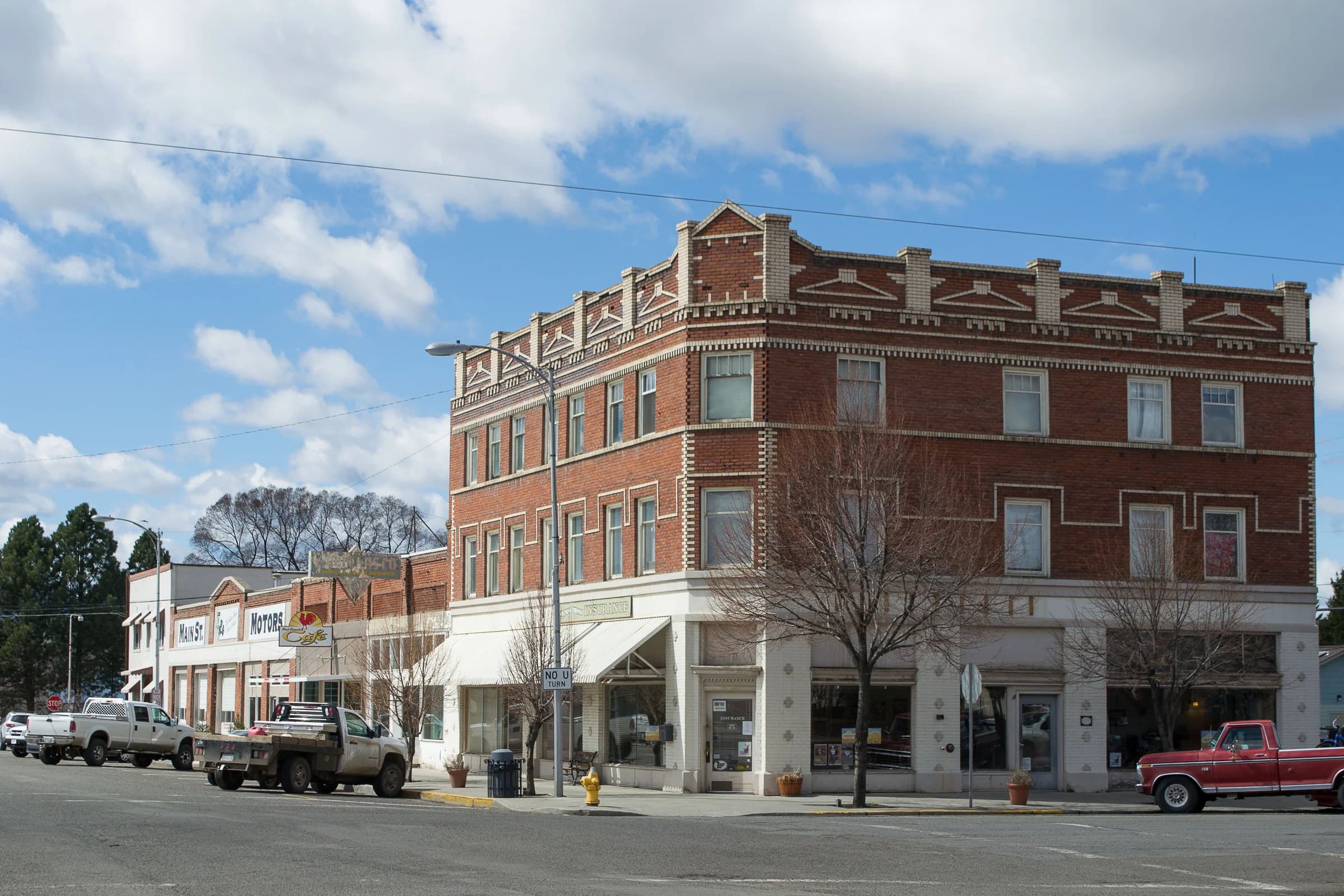
In 1935 the city of Enterprise argued about tearing down the Enterprise Mercantile and Milling Company building on Main Street; the county fixed the roof instead and built apartments inside. Ninety years later the building is being fixed again, one empty apartment at a time, with 27 homes still upstairs and residents from their twenties to their seventies 1. People in Enterprise pointed to it as proof of two things: that the county has housed its workers downtown before, and that nobody objects to a four-storey building if it is a hundred years old. The objection, several people said, is to anything new that stands between a person and the mountain 1.
The figures first. The county has about 4,349 homes. 962 are vacant, and of those 630 are kept for the season. The median home that an owner lives in is worth $394,800; the median household earns $67,112 a year; one is 5.9 times the other 2. Of the 86 county residents who answered a 2021 survey, five percent agreed that affordable housing was available where they live 3. The county’s 2021 economic analysis found that “the need for housing cuts across all discernable socio-economic lines,” and the regional needs assessment the same year called workforce housing “the biggest concern for interviewees,” with broadband second 10, 23. One brokerage’s sales cards show the median house in Joseph going from $256,000 in 2020 to $550,000 in 2025, in Enterprise from $225,000 to $395,000, in Wallowa from $190,000 to $449,000 4. People in Wallowa described this as a Joseph export, moving down the valley as buyers priced out of Joseph move to Enterprise and buyers priced out of Enterprise move to Wallowa and commute 1.
What a house in town sold for, 2020 and 2025
One brokerage’s broker-involved sales from the regional listing service, as summarised on its yearly cards and shared with the atlas. Small counts move the medians, especially in Wallowa and at the lake. Joseph roughly doubled in five years; people in Wallowa described the rise as a Joseph export, moving down the valley as buyers are priced out of Joseph, then Enterprise.
Source: Buyer origins 2020–2025 and the market in October 2026, Ruby Peak Realty, Enterprise, October 2026.
The numbers as a table
| 2020 median sale | 2025 median sale | |
|---|---|---|
| Joseph | $256,000 (20 sales) | $550,000 (22 sales) |
| Enterprise | $225,000 (37 sales) | $395,000 (33 sales) |
| Wallowa | $190,000 (5 sales) | $449,000 (15 sales) |
| Wallowa Lake | $355,000 (17 sales) | $378,000 (6 sales) |
The cases people gave were particular. A kitchen that is always hiring, because cooks cannot find a place to live. State and nonprofit jobs that go unfilled for the same reason. Emergency-room nurses who must live within twenty minutes of the hospital, which rules out the town of Wallowa. A couple who came home with three children and no jobs and could buy only because they had sold a house in Portland. Workforce housing in a Wallowa subdivision that neighbors called low-income housing, when the residents were people with steady jobs. Rents of about $1,200 a month for two bedrooms and $1,600 to $1,800 for a family house, with calls for rentals coming into one office a couple of times a week 1, 4.
When people said “the housing problem” they were describing at least three problems, and they do not have the same fix. The first is lots. Two people, one of them a mayor speaking at the forum, said buildable lots exist inside the towns and their owners will not sell; a broker counted three lots listed in all of Enterprise, much of which lies in a floodplain where insurance adds to the cost of anything built. The second is old houses. Three people, from different sides, said the gap is houses too run down to finance: a bank will not lend on them, renovation loans are cumbersome, and so they sit. The third is new houses, and here the arithmetic is unforgiving. A buyer in October 2026 was quoted about $375 a square foot for new construction. A serviced lot in a Joseph subdivision costs about $100,000. A 1,500-square-foot house therefore costs more than half a million dollars before anyone earning the median income can bid. “How can you build an affordable home, under $300,000, with that cost?” a Ruby Peak Realty broker asked, in words she approved 4. At $375 a square foot, $300,000 buys 800 square feet on free land.
One home in seven is kept for the season
The county’s 4,349 homes in the 2020 to 2024 estimates.
The seasonal count is the only published measure of second homes, and it misses homes owned from outside but rented out. People in conversation put the second-home share at about one in four; the two people who sell houses said most true second homes are cabins at the head of the lake.
Source: American Community Survey 5-Year Estimates 2020–2024, Wallowa County: Data Profiles DP03, DP04, DP05 and Detailed Table B25004, U.S. Census Bureau, 2020–2024 five-year estimates.
The numbers as a table
| Housing units | Share | |
|---|---|---|
| Lived in year-round | 3,387 | 77.9% |
| Vacant, kept for seasonal or recreational use | 630 | 14.5% |
| Vacant for other reasons: for sale, for rent, between tenants, other | 332 | 7.6% |
That last number matters because $300,000 is the ceiling in a bill a state representative described at the forum, which would let ranch families carve non-productive land off a ranch for homes under that price, the “second-generation housing” that Oregon’s land-use law, with its rule of one homestead per ranch, now prevents 1. The county’s officials support it. The land trust’s whole purpose, by contrast, is to keep farm and forest zoning from being carved up, and the same week produced people who fear exactly that: ranchettes, houses spreading on the hill above the Enterprise approach, Sun Valley as the warning 1. Here is the real fault line among the people who all want children to stay: housing on the ranch, or housing in town.
Housing in town has its own record, and it is a record of agreement on the goal and a veto on the means. Every proposal that would add homes inside a city has met resistance at a planning commission over character 1. One workforce-housing project on 20 acres inside Joseph’s city limits was dropped after neighbors objected and its sponsor judged it could not carry the whole thing; the land is now headed for a private subdivision of about fifty lots, with a variance from sidewalks and gutters 1. People who have watched this for years described the vocabulary that does the work: “affordable” is avoided because it is heard as subsidized; “it’ll turn into Portland”; and, from the same people, complaints that the restaurants are understaffed. One person who grew up here was blunter: most people do not want much change, and change is coming anyway 1.
Then there are the second homes, which nine people raised unasked and which carry more feeling than evidence. Most of the nine would charge them something: a levy, a fee, a surcharge on a utility bill of the kind one Oregon coast city is weighing. Three people put the share of second homes county-wide at about one in four. The two people who sell houses for a living said the share is overstated: the real second homes are the cabins and condominiums at the head of the lake, built on old small lots and not suited to year-round living, and in the three towns the share is much smaller. A transfer tax to feed a housing fund was recommended to the county about fifteen years ago and died as politically impossible; in 2012 Oregon voters amended the constitution to forbid new real estate transfer taxes anywhere in the state 1, 26. The census counts 630 seasonal homes, 14.5 percent of the stock. No one has counted how many homes are owned from outside the county. The assessor could, from tax-statement mailing addresses, though that count would sweep in rentals, investment property, trusts and companies, and so would overstate the thing people are worried about 2, 4. The county’s officials prefer the lodging tax as the channel, which taxes visitors rather than owners. A count would cost almost nothing and would settle the one number that every housing argument in the county is quietly built on.
Half the buyers were local or coming back
The 486 buyers one brokerage served from 2020 through 2025.
Ruby Peak Realty’s own tally, corrected by the office in October 2026: 48.5 percent local or returning, the largest single group but not a majority, and 22.8 percent from western Oregon. One office’s buyers, not the whole market. The office’s ‘investment or second home’ column mixes local buyers and commercial property, so it is not a second-home count.
Source: Buyer origins 2020–2025 and the market in October 2026, Ruby Peak Realty, Enterprise, October 2026.
The numbers as a table
| Buyers | Share | |
|---|---|---|
| From Wallowa County, or returning to it | 236 | 48.6% |
| From western Oregon | 111 | 22.8% |
| From elsewhere: eastern and central Oregon, Washington, Idaho, California and beyond | 139 | 28.6% |
Who is buying is better known than people think. Of the 486 buyers one brokerage served from 2020 through 2025, 236, or 48.5 percent, were from the county or returning to it, the largest single group though not a majority; 22.8 percent came from western Oregon 4. The entry-level buying by returning young people happened when mortgage rates were near three percent and has stopped; most buyers now pay cash or are waiting on a sale somewhere else 4. The home nobody can build is the one a nurse, a teacher or a lineman can carry on a county wage, and the market, left to itself, has not built it since rates rose.
Who keeps the place going
On the night of August 11, 2022, hail broke windows across the town of Wallowa. A lumber yard in Joseph brought plywood, and covering the holes took a night. The state’s Emergency Board approved money six weeks later; contractors were already short. A disaster case manager, paid by a $10,000 church grant, served 324 Wallowa households between October 2022 and April 2023 and closed 30 cases 39, 40, 30. In October 2026 people in Wallowa said the recovery was largely complete, that nearly every building has a new roof and some houses look better than before, and that it took years of insurance fights and a contractor backlog to get there 1. The storm is the clearest test the county has had of what it can do for itself in a hurry, and the answer was: the first night, everything; the first winter, not nearly enough.
Covering the holes took a night. Fixing the houses took years.
Served is not rebuilt, and a closed case is not a restored house. The story of the storm, with every source, is in the essay After the hail.
Sources: Eastern Oregon town damaged by hail storm recovers together, Oregon Public Broadcasting, Think Out Loud (Sage Van Wing; host Dave Miller interviewing Mayor Gary Hulse), August 25, 2022; State sends millions to Eastern Oregon to deal with storm damage, pollution, Oregon Public Broadcasting (Antonio Sierra), September 29, 2022 (Emergency Board meeting September 23, 2022); Honor UMCOR Sunday & OR-ID Disaster Response on March 15, Oregon-Idaho Annual Conference, The United Methodist Church, February 18, 2026 (grant period October 2022–April 2023); Conversations in Wallowa County, October 2–14, 2026, Wallowa Atlas, October 2026.
The numbers as a table
| When | What happened |
|---|---|
| August 11, 2022 | Hail smashes windows across the town of Wallowa in the night. |
| The first days | A lumber yard in Joseph brings plywood; two weeks on, the mayor estimates the share of homes damaged. |
| September 23, 2022 | The state’s Emergency Board approves money for the town. Contractors are already short. |
| October 2022 to April 2023 | A disaster case manager, paid by a $10,000 church grant, serves 324 Wallowa households; 30 cases are closed. |
| October 2026 | People in Wallowa say the recovery is largely complete: nearly every building has a new roof, after years of insurance fights and a contractor backlog. |
Care is the county’s largest employer and its largest exposure at once, and it is where the week’s most consistent agreement lay. Six people said elders have nowhere to go. There is no assisted living, no step between the family house and leaving the county, and no way for an older couple to downsize so that a family can move into the house they leave. More than half the county’s residents, 55.7 percent, left it for medical care in the past year 15. An attempt to build senior condominiums on four acres in Enterprise could not be financed. A search for funding is under way for a senior community that would put long-term care, assisted living and senior housing together; a broker reported several older people who would move to something easier if it were “nice,” because “affordable” carries a stigma; the development district said a progressive independent-to-assisted model would free up houses across the county 1. Six sources, a design, a location and demand evidence: no other idea of the week was this far along.
At the other end of life the shortage is the same shape. The hospital’s child care, about sixteen places opened for staff families, is full and loses money 38, 1. A Head Start closed because no certified teacher could be found. In 2019, 17 percent of the county’s children under six had access to a regulated child care slot, against 23 percent statewide; the regional assessment reports zero center-based preschool slots in the county on 2022 data 16. The hardest jobs to fill in health care are the mid-level clinical ones, and the answer the hospital has settled on is to grow its own 1. A worker’s ability to take a job here, one person observed, depends on a set of arrangements around the job, a house, a day care, a drive, a parent who needs looking after, and a housing plan that ignores the rest misses why a household still cannot make the move 1.
The institutions that hold the rest together are small and run by the same people. Seven of about twenty said the same few hundred people run the fair, the festivals and the boards, and that they are tired. Men between twenty and forty are absent from programs and boards county-wide. A band night at a bar in Enterprise was full of people in their late twenties and thirties, half of them known to the organizer and none of them on a board; many were newcomers nobody has asked. At the courthouse, department heads are doing the work of four. A shared grant-writing service that the county and its four cities could buy into already exists at the development district, with writers already under contract; no local government has yet brought money to use it, because the barrier is purchase money, match and hours, not a mechanism. The county has centralized its grant applications and is piloting software to find them instead 1. The 2009 Vital Wallowa survey found 91 percent of adults believed people here were willing to help their neighbors and 55 percent believed local government could deal effectively with important problems; nothing heard in 2026 suggests either number has moved 18.
And then there are the dinners. In 2024 a Methodist congregation in Joseph began free Monday-night dinners at The Place on South Lake Street, to meet hunger and loneliness in the same room. About 125 people came to the first. Attendance ran around 250 in the second season, and on March 23, 2026, the dinner served more than 385 meals, cooked by local chefs taking a Monday each and paid for by sponsors from Building Healthy Families and Wallowa Resources to the land trust and the service clubs 17. A second series now runs in Wallowa on eight fall Sundays, in its third season, organized by members of a Lostine church; one person who helps run it put a night at about 150, all ages and all incomes, with local ingredients where possible and many groups involved so that people feel it is theirs, and described a table where someone who gave the school $50,000 sat next to someone who needed a hot meal 1. Nobody proposed the dinners as policy. They are the county’s actual care infrastructure, built by churches with sponsors, and they are growing faster than anything else on this page.
Joseph’s free Monday dinners tripled in three seasons
Meals served, as counted by the organizers.
The Joseph United Methodist congregation’s Monday Night Community Dinners run February through April, cooked by local chefs and paid for by sponsors. A second series runs in Wallowa on fall Sundays, in its third season; one person who helps run it put a night at about 150, with people who gave the school $50,000 at a table with people who need a hot meal.
Sources: Joseph Community Dinners serve record breaking 385 meals, Elkhorn Media Group, from a Joseph Mainstreet release, March 30, 2026; Conversations in Wallowa County, October 2–14, 2026, Wallowa Atlas, October 2026.
The numbers as a table
| People at a dinner | |
|---|---|
| First dinner, 2024 | 125 |
| Typical, 2025 | 250 |
| March 23, 2026 | 385 |
Deciding for itself
The people who want the pace of change kept did not describe themselves as against change. They described a county that has decided its own course before and paid for it. The moraines above Wallowa Lake, where a 69-lot subdivision was stopped and a collaborative of 72 private landowners was assembled under the county commissioners, and where in January 2020 the county itself took ownership of 1,791 acres of the East Moraine after almost $6.5 million was raised, with an easement in January 2023 that extinguished the right to build there for good 1, 19, 20. The salmon plan the county and the Nez Perce Tribe wrote in the 1990s before anyone made them, which became an advisory committee and then, in 1996, Wallowa Resources 1. The airport kept at Joseph. The vision statement of 2006 that asked for “wide-open spaces and intact ranchlands,” for ways to “carry agriculture and ranching forward into the next generation,” and for “a County with no mega anything” 18. The people who want change pointed to the same record as proof that the county can act when it decides to.
The county has decided for itself before
The choices people pointed to when they said the place should keep its pace.
People who want the pace of change kept pointed to the moraine, the vision statement and the airport kept at Joseph; people who want change pointed to the same record as proof the county can act. The border votes show how close its arguments run.
Sources: Stewardship, education, and rural livelihoods, Wallowa Resources, Undated page; Vital Wallowa Indicator Project: 2009 Baseline Assessment Report, Oregon State University Extension Service and Rural Studies Program, with Wallowa Resources, NEOEDD and The Ford Institute for Community Building, February 2010; data vintages 2000–2009; 1,791 Acres of Wallowa Lake’s East Moraine Acquired for Wallowa County, Wallowa Land Trust, January 21, 2020; Final Hurdle Cleared to Permanently Protect East Moraine Community Forest, Wallowa Land Trust, February 8, 2023 (signing January 26, 2023); News release on the Wallowa Lake Dam agreement, September 23, 2020, Oregon Department of Fish and Wildlife, September 23, 2020; Marginal ‘Greater Idaho’ vote tightens to single digits in Wallowa County, OR, KOIN, June 2023; Election: Wallowa County voters repeal Greater Idaho meeting requirement, Wallowa County Chieftain, May 19, 2026; Wallowa Lake Dam work gets underway, Wallowa County Chieftain, September 3, 2026.
The numbers as a table
| When | What happened |
|---|---|
| 1996 | Wallowa Resources is formed in Enterprise after the mills close, to keep working land and work together. |
| 2006 | A county vision statement asks for “wide-open spaces and intact ranchlands” and “a County with no mega anything.” |
| 2009 | The first Vital Wallowa reading finds the county “roughly three-quarters vital, with some clear work to do.” |
| January 2020 | 1,791 acres of the East Moraine above Wallowa Lake pass into county ownership after almost $6.5 million is raised. |
| September 2020 | The irrigation district, the Nez Perce Tribe, the Umatilla tribes and the state agree on water releases from Wallowa Lake, the condition for rebuilding the dam with fish passage. |
| January 2023 | An easement makes the moraine’s protection permanent. |
| May 2023 | A measure requiring the commissioners to discuss joining Idaho passes by seven votes. |
| May 2026 | Voters repeal it, 2,044 to 1,319. |
| September 2026 | Work begins on the dam, with a fish ladder to follow by 2028. |
The dam at the lake’s outlet is the case everyone gives for what the county can do when the irrigators, the county and the tribes build one thing together, and it is the biggest thing happening in the county right now. The concrete dam was built with no way for a fish to pass it, and the lake that once had Oregon’s only sockeye run in the Snake basin lost that run a century ago. In 1996 the state listed the dam as high-hazard and the irrigation district could store only about 70 percent of its water. In September 2020 the district, the Nez Perce Tribe, the Confederated Tribes of the Umatilla Indian Reservation and the state fish agency agreed to release up to 5,000 acre-feet of water a year for the rivers below, which was the condition for $14 million in state lottery money 28. The tribes insisted on a ladder rather than trucks; the courts agreed; and on September 2, 2026, a crew began work under a first-phase contract of $31.6 million, with the fish ladder to follow by 2028 and sockeye eggs from Idaho already hatched and released so that returning adults can seed a new run 29. It took eight years of paper. Several people named it as the model for everything else.
A century without a way past, then eight years of paper, then a crew
People named the dam as the biggest thing happening in the county and the clearest case of the irrigators, the county and the tribes building one thing together. Sockeye eggs from Idaho were hatched and released in 2024 so that returning adults can seed a new run.
Sources: Wallowa Lake Dam Rehabilitation Project: testimony and project fact sheet to the Joint Subcommittee on Capital Construction, Oregon State Legislature, submitted for the Wallowa Lake Irrigation District, 2021; Nez Perce pursue plan to return sockeye to Wallowa, Columbia Basin Bulletin, 2003; News release on the Wallowa Lake Dam agreement, September 23, 2020, Oregon Department of Fish and Wildlife, September 23, 2020; Wallowa River Fish Passage and Flow Restoration (Infrastructure Investment and Jobs Act focal area), Oregon Department of Fish and Wildlife, 2023; Appeals court ruling on Wallowa Lake Dam is moot, Wallowa County Chieftain, January 9, 2026; Wallowa Lake Dam work gets underway, Wallowa County Chieftain, September 3, 2026.
The numbers as a table
| When | What happened |
|---|---|
| 1919 | The irrigation district dates the first concrete dam at the lake’s outlet to this year; it is raised in 1920 and 1929, with no way for a fish to pass. |
| 1926 | The last sea-run sockeye anyone remembers is seen in the Wallowa River, the year the dam reaches full height. Canneries had taken about 12,000 sockeye in two years in the 1880s. |
| 1996 | The state lists the dam as high-hazard. The district may store only about 70 percent of the water it holds rights to. |
| September 2020 | The district, the Nez Perce Tribe, the Umatilla tribes and the state agree to release up to 5,000 acre-feet a year for the rivers, the condition for $14 million in state lottery money. The estimate is about $16 million. |
| 2022 | A federal conservation fund gives the tribes just over $5 million to reconnect the lake for sockeye. The estimate reaches $21 million. |
| December 2025 | The Court of Appeals throws out a rule that would have let the dam’s owner trap fish and truck them around it. The district had already agreed to a ladder. |
| September 2, 2026 | Work begins under a first-phase contract of $31.6 million: a lowered spillway, new gates and outlets, a screened intake. The ladder follows, to finish in 2028. |
Whether the county can change is also a question about who belongs in it, and here the conversations divided along a line that has a geography in residents’ minds. People in Wallowa and Enterprise said their towns are what they were and Joseph is where the county changed: overrun in summer, a place where a long-time resident knows nobody on the street in July. Newcomers, in this account, bring their politics with them. People in Joseph and in the arts described the same arrival from the other side: a revolving door through which people who feel different leave; a county in which members of one party are ostracized; a politics that is a reason some people keep to themselves. Three people, from different sides, said politics is now a reason people leave or stay quiet 1. What the record can add is that the county has never voted one way. In 2023 a measure requiring the commissioners to discuss joining Idaho passed by seven votes after the final count. In May 2026 the county repealed it, 2,044 to 1,319 21, 22.
The other division is quieter and may matter more. The county keeps two calendars. One runs through the writers’ gatherings, the courthouse concerts, the songwriters’ nights and the music festival; the other through the rodeo, the fair, Friday-night football and the churches. The people who run the first said the two worlds do not share people, music or organizers, and that what the second world wants is a bowling alley and a swimming pool, both of which the county once had. “The people that think there’s nothing to do are not the people that come to Fishtrap Fireside or Tunesmith Night,” said Janis Carper, who runs the music alliance, in a line she approved 1. Being known by name, three people said in different words, is not the same as belonging, and a person can live here for years with everyone knowing who she is and no one knowing her.
The Nez Perce (Nimiipuu) people are the oldest fact about this county and the one the week handled most carefully. What is public is this. Their homeland was this valley; the 1863 treaty cut the reservation to a tenth of its size around Lapwai and left the Wallowa country out; in 1877 the Wallowa band was driven from it, and its descendants live today in three nations, at Lapwai in Idaho, at Umatilla in Oregon and at Colville in Washington 41. In the town of Wallowa a nonprofit, the Nez Perce Wallowa Homeland, holds grounds along the river that are dedicated to Native use, open to the public, and host each July the Tamkaliks celebration, three days of dancing, teaching and a Sunday friendship feast to which residents and visitors are invited; its strategic plan runs one hundred years 31, 32, 33. The county, the irrigation district and the tribes are building the dam together. A Joseph nonprofit formed in 2023 trains Nez Perce descendants and other Native youth to guide the rivers of the homeland, and its film about one of them is on this atlas. The three conversations the atlas had about return, with people who can speak to it, will appear here in their own words when they have approved them.
What they want
Asked what the county should be like in twenty years, people answered with values before they answered with plans, and the values were nearly unanimous. Working land kept and healthy, in the hands of people who work it. More of the value of what the county produces staying in the county. A younger generation on the land and in the towns. Elders able to stay. Growth, if any, modest and young. A Main Street that is the town’s living room, appealing first to the people who live there. Public access to the mountains and the rivers kept. The character kept: no street lights, waving at everyone, “no mega anything.” One older resident’s whole answer to the twenty-year question was: don’t change it. A younger one’s was that without change there will be no young people. Both, pressed, wanted the same thing, which was for their children and their neighbors’ children to be able to live here 1.
The plans people named were smaller than the values and more concrete, and this page records them as they stand, not as recommendations. A senior community combining care and housing, with funding now being sought. A second grocery store in Enterprise. Run-down houses brought back into use, with a loan product a bank will actually make. Small owners building a few rentals each, as one business owner did with four apartments. Duplexes, triplexes and backyard homes inside the towns, built before anyone touches the farm zoning. A county-wide housing needs analysis, which the state funds only city by city. A count, from the assessor, of homes owned from outside the county, split between the lake and the towns. A refresh of the 2009 Vital Wallowa indicators, so the county can measure itself against its own goals again. A paid year of public-sector grant writing that uses the service already procured. A second fiber line into the county, so that it no longer depends on one. A volunteer fair at Cloverleaf Hall, and someone to ask the newcomers at the band nights why they came. The state bill for homes under $300,000 on ranch land, which has a named local supporter and a named local opponent. A fee on second homes, which most people would support privately and no one has championed in public. A bowling alley and a swimming pool 1.
What would change the picture is not another opinion. It is four counts that nobody has: how many homes are owned from outside the county, by the lake and by the towns; how many rentals exist year-round, by town and by size; how many child care slots there are, and who keeps the number; and what the county needs in housing by income band, which one estimate put at 80 to 100 units in the middle. Each of these is a few weeks’ work for someone with the authority to ask, and each would end an argument that has run for years on feeling. The atlas has asked for the first and the last. It will publish what comes back, and it will publish the fact if nothing does.
Who has not been heard is as important as who has. A working rancher speaking for the ranch, not through an official. A logger or forestry contractor, in a trade one contractor expects to leave the county within five or six years. A renter and a wage worker speaking for themselves. A second-home owner, since no one has interviewed one and the county’s philanthropic base lives among them. Anyone under thirty-five who is not running an institution. Someone who left. And the Nez Perce people who can speak to return, whose words are theirs to release. The nine questions on the Home in 2046 page are open to all of them, and answers are published only with the writer’s permission and in the writer’s words. One organization has offered its room for a listening session this winter.
The county has held its number for sixty-five years by doing something no forecast models: deciding, each time, what it would not become. It would not be Sisters or Bend. It would not sell the moraine. It would not truck fish around a dam. The decision in front of it now is different in kind, because it is not about what to refuse. Nineteen of twenty local seats had one candidate. The same few hundred people are tired. One resident in eight is a schoolchild, where one in four was. A house costs six years of a household’s income. The people who want the place kept and the people who want it changed want the same children to stay, and the next twenty years will be decided by whether the county can agree on a house, a lot and a street for them, in the same breath in which it agrees on the character. Everything the record shows says it can. Everything the record shows says it has not yet.
Nine questions about the next twenty years.
Answers are published one at a time, only with your permission and in your own words, and the themes are counted without names.
What makes this home?
Tell us about an ordinary moment that explains what makes this place home for you.
Respond in your own words Imagine & reflectA life here in 2046
Imagine an ordinary day here in 2046 after twenty good years. Who is able to live here, and what made that possible?
Respond in your own words Imagine & reflectComing home
What does being at home in Wallowa country mean to you, and what would make it easier for you or the next generation to be here?
Respond in your own words Imagine & reflectThe work behind the view
What work on the land do you want the next generation to be able to continue, and what would need to change to make that possible?
Respond in your own words Share an experienceWhen neighbors show up
Tell us about a time someone here helped you, or a time the help you needed was hard to find. Share only details you want made public.
Respond in your own words Imagine & reflectSkills worth passing on
What do you know how to make, repair, grow or do that you would like someone younger to learn? What would help them earn a living doing it here?
Respond in your own wordsSources
Numbers in the text refer to the sources below; “p.” means printed page.
- Conversations in Wallowa County, October 2–14, 2026 ↗Wallowa Atlas · October 2026Private field notes from about twenty recorded or noted conversations in Enterprise, Joseph and Wallowa in the first week of October 2026, three phone calls in the second week, and the October 4 candidate forum at Cloverleaf Hall; themes counted by how many people raised them without being asked
Reported experience, not a survey. Most conversations were with people who run an institution; few were with anyone under 40; the county’s conservative majority is thinly represented. A count is of people who raised a theme, not of its weight. No one is named or quoted without a written yes; anything said about a neighbor, employee or tenant was left out; three conversations about the Nez Perce homeland are being reviewed with the people they belong to and are not counted here.
Checked 2026-10-14 - American Community Survey 5-Year Estimates 2020–2024, Wallowa County: Data Profiles DP03, DP04, DP05 and Detailed Table B25004 ↗U.S. Census Bureau · 2020–2024 five-year estimatesDP04 total, occupied and vacant units and median value; B25004_006E seasonal vacancy (±130); DP03_0062E median household income
Five-year averages, not point-in-time counts. The price-to-income ratio (5.9) and the seasonal share of stock (14.5%) are arithmetic on the estimates.
Checked 2026-09-14 - Oregon Voices Data Summary: Wallowa County ↗The Ford Family Foundation, with ECONorthwest and PSU Regional Research Institute · April 2023; fielded from summer 2021Pages 1–7
86 respondents (77 random-household, 9 engagement), average age 63, eight in ten homeowners; the summary publishes no renter count. Unweighted, no margin of error published.
Checked 2026-09-14 - Buyer origins 2020–2025 and the market in October 2026 ↗Ruby Peak Realty, Enterprise · October 2026Sales cards (RMLS broker-involved sales) shared by one of the office’s principal brokers, October 2–3 and 8, 2026: 236 of 486 buyers from the county or returning (48.5 percent), western Oregon 22.8 percent; 156 ‘investment or second home’ purchases 2020–2024. Market figures from a principal broker, October 5 and 7, 2026: 79 residential listings, 17 between $250,000 and $350,000; rents about $1,200 (two bedrooms) and $1,600–$1,800 (family house); a Joseph subdivision lot with utilities about $100,000; new construction quoted at about $375 a square foot
One office’s broker-involved sales, not the whole market, and a listing count is a snapshot of a week. The ‘investment or second home’ column includes local buyers and commercial property, so it is not a count of second homes. The brokers asked, in writing, that the figures be credited to the office rather than to them by name.
Checked 2026-10-08 - Coordinated Population Forecast for Wallowa County, its Urban Growth Boundaries (UGB), and Area Outside UGBs 2023–2073 ↗Population Research Center, Portland State University, for the Oregon Population Forecast Program (Marquez, Sharygin, Loftus, Alkitkat, Montcho, Swanson and Wilde, 2023) · June 25, 2023Pp.5, 9–11, 14, 17, 18
Current official forecast (Cycle 3, 2022–2025). Report distributed by the program as a PDF (direct copy: https://drive.google.com/file/d/1lOjdiv5V22XFYFSXLZ2r5LDCtvC2Digr/view). Table 2 is by urban growth boundary, not incorporated city limits. Five-year county totals cited are column sums of Table 5, validated against the report’s printed 2020, 2030 and 2040 figures.
Checked 2026-09-14 - Decennial Census population counts, Wallowa County, Oregon: 2000, 2010, 2020 ↗U.S. Census Bureau · April 1 counts, 2000, 2010, 2020Tables DECENNIALSF12000.P001 (P001001), DECENNIALSF12010.P1, DECENNIALPL2020.P1 (P1_001N), geography 0500000US41063
County totals 7,226 / 7,008 / 7,391; they match the PSU report’s Table 1.
Checked 2026-09-14 - 2010 Census of Population and Housing, Population and Housing Unit Counts, Oregon (CPH-2-39) ↗U.S. Census Bureau · 2012Table 4
April 1 counts; the report’s user notes describe boundary changes between censuses.
Checked 2026-10-14 - 1970 Census of Population, Volume 1, Part 39, Oregon: Table 9, Population and Land Area of Counties: 1970 and 1960 ↗U.S. Census Bureau · 1973 (data as of April 1, 1970 and 1960)p. 39-15
A scanned table; the digits were read from the page image.
Checked 2026-10-14 - Fall Membership Report 2025-26 (with 2015-16 for comparison) ↗Oregon Department of Education · October 2025 count; file posted February 12, 2026District worksheets for October 2015 and October 2025
Four-district totals 857 (October 2015) and 878 (October 2025) are our sums of the district rows (Enterprise 404/425, Joseph 242/249, Wallowa 209/199, Troy 2/5); the files print no county total. The 2015–16 worksheet is keyed on attending district, the 2025–26 worksheet on district of enrollment. The 2009–10 figure (872) is from the 2021 EOA’s Table 2, a separate tabulation of ODE data.
Checked 2026-09-14 - Economic Opportunity Analysis: 2021 — Wallowa County ↗Wallowa County Board of Commissioners; prepared by PARC Resources with Oregon DLCD and Business Oregon · 2021 (TAC meetings June 2020–April 2021)Printed pp.2, 10, 14–15, 25, 28, 70, 74
Planning document; its vision was drafted by a six-member committee under pandemic limits. The p.25 lumber figure is a typo; p.28 governs. The two transfer-payment shares on p.15 are the document’s own unreconciled conflict. Table 17 rent figures are undated.
Checked 2026-09-14 - 1970 Census of Population, Volume 1, Part 39, Oregon: Table 120, Educational and Family Characteristics for Counties ↗U.S. Bureau of the Census · 1973 (data as of April 1, 1970)Page 39-250, Wallowa County column, school enrollment: total enrolled 3 to 34 years old 1,719; nursery school 7; kindergarten 17 (public 12); elementary, grades 1 to 8, 1,014 (public 998); high school, grades 1 to 4, 614 (public 594); college 67. Total population 6,247 from Table 119, page 39-247
Sample-based figures (the 1970 census asked these questions of a sample of households), so each count carries sampling error; the kindergarten-through-high-school total of 1,645 is the atlas’s sum of three rows. Residents enrolled anywhere, not pupils of the county’s schools.
Checked 2026-10-14 - CAINC4: Personal income and employment by major component, Wallowa County ↗U.S. Bureau of Economic Analysis · 2024 estimates, released 2025County rows for Wallowa County, Oregon: personal income ($509.3 million); personal current transfer receipts ($147.9 million); dividends, interest and rent ($108.1 million); government and government enterprises earnings ($79.7 million); farm earnings ($24.9 million); per capita personal income ($67,705)
Place-of-residence income. ‘Government’ earnings here include local government employers such as the hospital district and the school districts. Transfer receipts are mostly Social Security, Medicare and Medicaid. Figures are nominal dollars.
Checked 2026-10-11 - Quarterly Census of Employment and Wages, annual averages, Wallowa County (area 41063), 2022–2025 ↗U.S. Bureau of Labor Statistics · 2025 annual averages (2022–2024 also cited)Rows agglvl 70 (county total), 71 (by ownership), 74–78 (by NAICS); disclosure_code N marks suppressed cells
Covered payroll jobs only; excludes proprietors and the self-employed. Suppressed cells are unknown, not zero. NAICS 236115: 66 jobs across 29 establishments in 2025; ‘about two apiece’ is arithmetic.
Checked 2026-09-14 - Quarterly Census of Employment and Wages, annual averages, Wallowa County (area 41063), 2015 ↗U.S. Bureau of Labor Statistics · 2015 annual averagesRows agglvl 70 and 71
NAICS 2012 basis; county totals comparable with 2025, industry detail only loosely. Earliest year this endpoint serves is 2014.
Checked 2026-09-14 - Wallowa Memorial Hospital 2025 Community Health Needs Assessment — Executive Summary ↗Wallowa Memorial Hospital and partners; hosted by OHSU Oregon Office of Rural Health · 2025 (PDF created November 26, 2025)‘Community Priorities’; ‘Aging Population’; ‘Outmigration for Care’; ‘Biggest Gaps in Service’
Four-page summary; cites no years, sources or sample sizes for its statistics. Priority ranking came from providers and community leaders, not a resident vote.
Checked 2026-09-14 - 2024 Community Health Assessment Report ↗Eastern Oregon Coordinated Care Organization · 2024 (data accessed November 2024; child care access figure 2019 vintage)Printed pp.70–71; child care access figure 2019, broadband 2018–2022, preschool slots 2022
Indicator tables for Wallowa; mixed vintages on one page. Child care access (17% vs 23%) is from the 2019 Oregon Child Care Desert report; broadband (81.5% vs 90.5%) is ACS S2801 2018–2022; zero center-based preschool slots is 2022 data.
Checked 2026-09-14 - Joseph Community Dinners serve record breaking 385 meals ↗Elkhorn Media Group, from a Joseph Mainstreet release · March 30, 2026Monday Night Community Dinners at The Place, 303 S. Lake Street, Joseph, February through April; about 125 at the first dinner in 2024, around 250 in the second year, more than 385 meals on March 23, 2026; run by the Joseph United Methodist Church congregation under Pastor Beth Estock, with sponsors named
A release from the organizers as published by a regional news site; the counts are the organizers’ own.
Checked 2026-10-13 - Vital Wallowa Indicator Project: 2009 Baseline Assessment Report ↗Oregon State University Extension Service and Rural Studies Program, with Wallowa Resources, NEOEDD and The Ford Institute for Community Building · February 2010; data vintages 2000–2009Printed pp.4, 9, 20–21, 32, 34–36, 42–43, 49–55, 58–60, 62
Reprints the 2006 vision (facilitated by NCSU faculty, guided by the Wallowa County Economic Action Team; no participant count) and takes a 2009 baseline on 26 indicators; survey n=276, ±5.8%. Farmland share is 2007, national forest share 2009. The indicators were developed ‘relying on the input from the community forums and the 2006 vision statement’ (p.4). Indicator 6 percentages rest on 57 parents reporting on 98 children; the report says the sample is not adequate for generalization.
Checked 2026-09-14 - 1,791 Acres of Wallowa Lake’s East Moraine Acquired for Wallowa County ↗Wallowa Land Trust · January 21, 2020Headline; ‘Push to protect moraine receives broad support’; ‘A Community Legacy’
Press release by the purchasing partnership; funding stack and acreage as stated. Acreage differs from later documents (1,820; 1,824).
Checked 2026-09-14 - Final Hurdle Cleared to Permanently Protect East Moraine Community Forest ↗Wallowa Land Trust · February 8, 2023 (signing January 26, 2023)Paragraphs 2–3; Katy Nesbitt quotation
Organization’s account of the signed easement, co-held with the Oregon Department of Forestry; gives 1,824 acres.
Checked 2026-09-14 - Marginal ‘Greater Idaho’ vote tightens to single digits in Wallowa County, OR ↗KOIN · June 2023After the final count the measure was seven votes ahead
Television report on the May 2023 county measure; the margin is as the station reported it after the count was finalized.
Checked 2026-10-13 - Election: Wallowa County voters repeal Greater Idaho meeting requirement ↗Wallowa County Chieftain · May 19, 2026Election-night count on Measure 32-011: 2,044 to 1,319; the 2023 measure required meetings every February and August; the last required meeting was February 25, 2026
An election-night count, not the certified abstract; the county clerk holds the final figures.
Checked 2026-10-13 - Community Needs Assessment ↗Northeast Oregon Economic Development District · May 2021; interviews January–early March 2021Printed p.14 (Built & Natural Environments); p.17 (Economic Development challenges)
Regional findings for Baker, Union and Wallowa counties from 70+ volunteer interviews; not disaggregated by county.
Checked 2026-09-14 - Wallowa County audits and adopted budgets ↗Wallowa County · Fiscal 2025 audit; fiscal 2026 adopted budgetFiscal 2025 audit: actual revenue, all funds ($11.5 million); transient lodging tax receipts ($612,998). Adopted budget: budgeted full-time-equivalent positions, 72.35 to 62.71
The lodging tax is 5 percent, so the receipts imply a taxable base near $12.3 million; that division is the atlas’s arithmetic, not a county figure. Budgeted positions are not filled positions.
Checked 2026-10-11 - House Bill 4148 (2026 Regular Session), transient lodging taxes ↗Oregon State Legislature · 2026 Regular Session; effective June 5, 2026The enrolled bill: the share of net local lodging-tax revenue that must go to tourism promotion or tourism-related facilities falls from 70 to 50 percent for taxes collected from January 1, 2027
The bill text; how the county will use the room it gains is the county’s decision and is not yet recorded.
Checked 2026-10-13 - Oregon Constitution, Article IX, unnumbered section: prohibition on real estate transfer taxes ↗Oregon State Legislature · Initiative petition filed March 4, 2010; adopted by the people November 6, 2012 (Measure 79)The unnumbered section at the end of Article IX, with its bracketed creation note
Forbids the state and local governments from imposing a tax, fee or assessment on the transfer of real property, except those in effect on December 31, 2009.
Checked 2026-10-14 - July 2026 Employment and Unemployment in Oregon’s Counties ↗Oregon Employment Department · August 25, 2026P.2, second paragraph
Total nonfarm payroll change by place of work; the release does not attribute the county’s 8.3% loss to any employer.
Checked 2026-09-14 - News release on the Wallowa Lake Dam agreement, September 23, 2020 ↗Oregon Department of Fish and Wildlife · September 23, 2020The release: parties to the agreement, the release of up to 5,000 acre-feet a year, and the link to the Legislature’s $14 million
The agency’s account of the agreement; the irrigation district’s and the tribes’ own statements are cited in the land-and-water chapter.
Checked 2026-10-13 - Wallowa Lake Dam work gets underway ↗Wallowa County Chieftain · September 3, 2026The September 2, 2026 start of work, the $31.6 million first-phase contract, the 2027 and 2028 schedule, and the sockeye release
A news report on the first day of construction; the ladder’s own price and design were not yet published.
Checked 2026-10-13 - Honor UMCOR Sunday & OR-ID Disaster Response on March 15 ↗Oregon-Idaho Annual Conference, The United Methodist Church · February 18, 2026 (grant period October 2022–April 2023)Bulleted list ‘OR-ID Conference UMCOR response by the numbers’, fourth bullet
Grantmaker’s retrospective; 324 households served and 30 cases closed are service counts, not repaired homes.
Checked 2026-09-14 - About Us — Nez Perce Wallowa Homeland ↗Nez Perce Wallowa Homeland (nonprofit) · Undated page; retrieved September 14, 2026‘Who We Are’ (self-description); ‘Our Work’; ‘Organizational History’
Self-description as ‘a landback nonprofit—not a tribal government’; dates the first Tamkaliks to 1989, while the Tamkaliks page says 1990.
Checked 2026-09-14 - Tamkaliks Celebration — Nez Perce Wallowa Homeland ↗Nez Perce Wallowa Homeland (nonprofit) · Undated page carrying the 2026 schedule (July 17–19, 2026); retrieved September 14, 2026Undated page with 2026 schedule; section “Tamkaliks: Beginnings”
Dates the first gathering to 1990, while the strategic plan and About page say 1989; the organization’s Foundation Document, which would settle it, is not published online. The July 17–19, 2026 dates are the announced schedule, not a record of the event held.
Checked 2026-09-14 - Strategic Planning — Nez Perce Wal’áwa Homeland 100-year strategic plan ↗Nez Perce Wallowa Homeland (nonprofit) · Adopted 2023‘Our Story’ (1989 date, 323 acres); pull quote attributed ‘Taz Conner, 1994’ between ‘Our Guiding Values’ and ‘Our Mission’; Goal ‘Reciprocal Relationships’ (10-, 30-, 100-year horizons; ‘address barriers to return’); funders list
A nonprofit’s stated intentions, distinct from the Nez Perce, Umatilla and Colville tribal governments, which it lists as contributors.
Checked 2026-09-14 - 2024 Gazetteer Files, counties, Oregon ↗U.S. Census Bureau · 2024Wallowa County row: land area 3,146 square miles
Land area only; water is counted separately. The 1970 census gave 3,178 square miles under an older measurement.
Checked 2026-10-13 - Payments in Lieu of Taxes ↗U.S. Department of the Interior · Payment years 2025 and 2026County payment lookup, Wallowa County, Oregon: 1,171,213 entitlement acres
The acreage the program pays on, which is the atlas’s basis for the 58 percent federal share; the share is the atlas’s arithmetic against the Gazetteer land area.
Checked 2026-10-11 - Payments in Lieu of Taxes, county payments, 2025 and 2026 ↗U.S. Department of the Interior · 2025 and 2026 payment yearsWallowa County, Oregon: $690,395 (2025); $1,497,560 (2026)
PILT offsets property tax the county cannot levy on federal land. The formula nets out certain other federal payments, so a lapse elsewhere, such as Secure Rural Schools, can raise the PILT amount in the following year; no published explanation of the 2026 increase was found.
Checked 2026-10-11 - Wallowa County gets backlog of SRS funds ↗Wallowa County Chieftain · May 5, 2026The $2.25 million Secure Rural Schools payment to the county in 2026 and its split among roads, schools and county projects
A news report; the program’s reauthorization in October 2026 is recorded on the county government page.
Checked 2026-10-13 - Workforce Introduction ↗Robert Barclay et al., Flex Monitoring Team · March 2025P.5, opening Wallowa Memorial paragraph
Short case study; opening date, operator and present status of the child care are not stated.
Checked 2026-09-14 - Eastern Oregon town damaged by hail storm recovers together ↗Oregon Public Broadcasting, Think Out Loud (Sage Van Wing; host Dave Miller interviewing Mayor Gary Hulse) · August 25, 2022Transcript; Hulse on the number of homes damaged
Mayor’s estimate two weeks after the storm, using homes on city sewer and water as the denominator; machine transcript.
Checked 2026-09-14 - State sends millions to Eastern Oregon to deal with storm damage, pollution ↗Oregon Public Broadcasting (Antonio Sierra) · September 29, 2022 (Emergency Board meeting September 23, 2022)Opening Wallowa section, before ‘Nitrates and flooding’
Approved funding is spending authority, not completed repairs; reports the contractor shortage.
Checked 2026-09-14 - History — Nez Perce Tribe ↗Nez Perce Tribe · Undated page; retrieved September 14, 2026‘Treaties’ section
The Tribe’s own account of the 1855 and 1863 treaties and reserved off-reservation rights; does not discuss the Wallowa country specifically.
Checked 2026-09-14